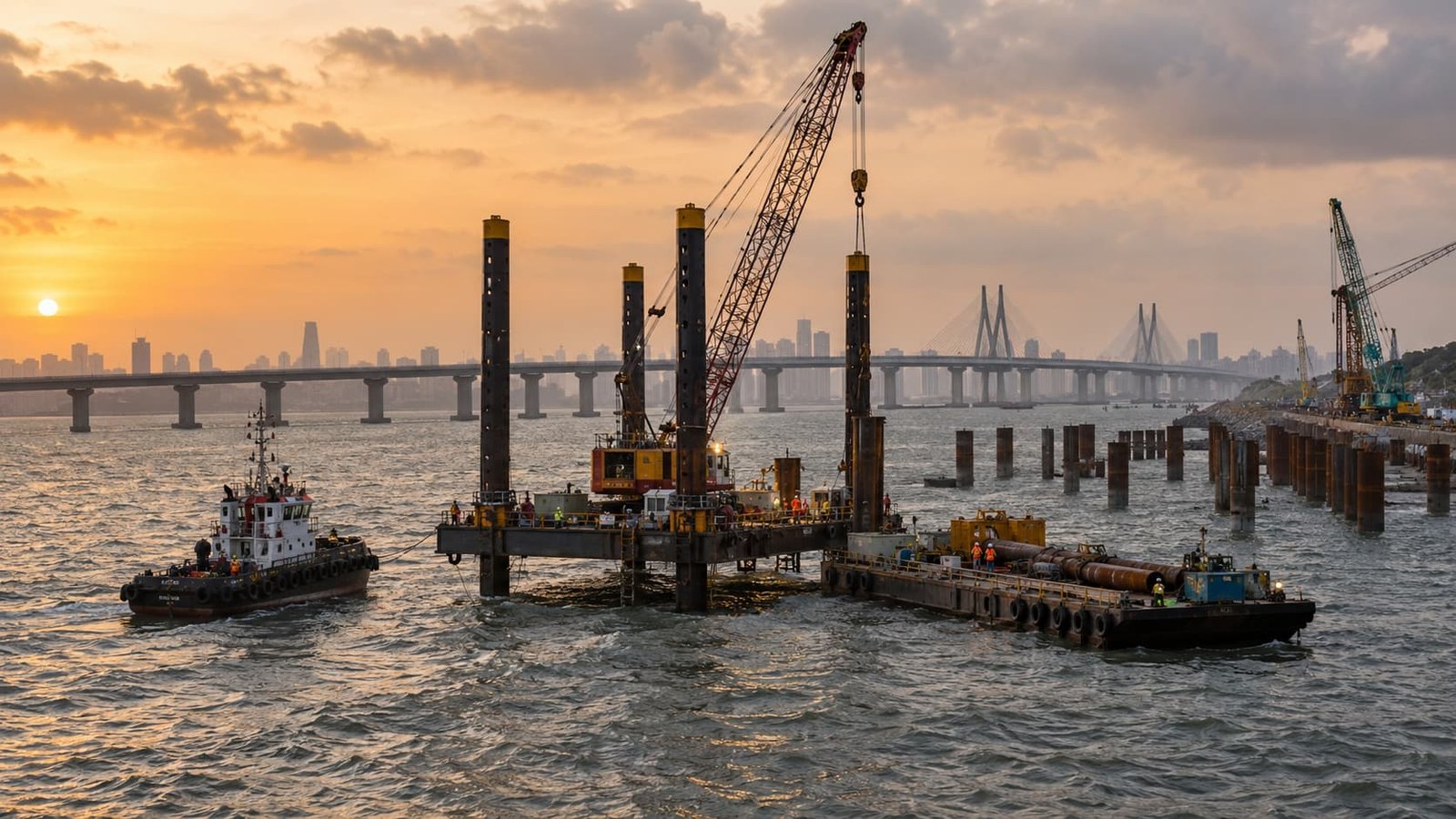
Most people who drive across the Atal Setu or along the Coastal Road never think about what held the construction crew steady while the sea moved beneath them. For the technicians who built it, that question decided which piece of equipment got deployed on which stretch of the job.
Mumbai’s marine infrastructure pipeline, bridges, coastal roads, port channel maintenance, gives a useful real-world view of where jack-up barges, pontoons and other specialised marine equipment actually get used, and why one type of barge suits one project while a different job calls for something else entirely. This guide walks through that, building on our earlier guides on how a jack-up barge works and jack-up barge operations in Mumbai harbour.
Why Mumbai generates so much of this kind of work
Mumbai’s geography puts water in the middle of almost every major infrastructure decision the city makes. A harbour that splits the city from Navi Mumbai, a western coastline under active road development, and a port handling a significant share of India’s container traffic all require construction methods that work from the water rather than around it. That combination makes Mumbai one of the more active markets in India for jack-up barges, pontoons and the tugs that move them.
Bridge construction: the Mumbai Trans Harbour Link example
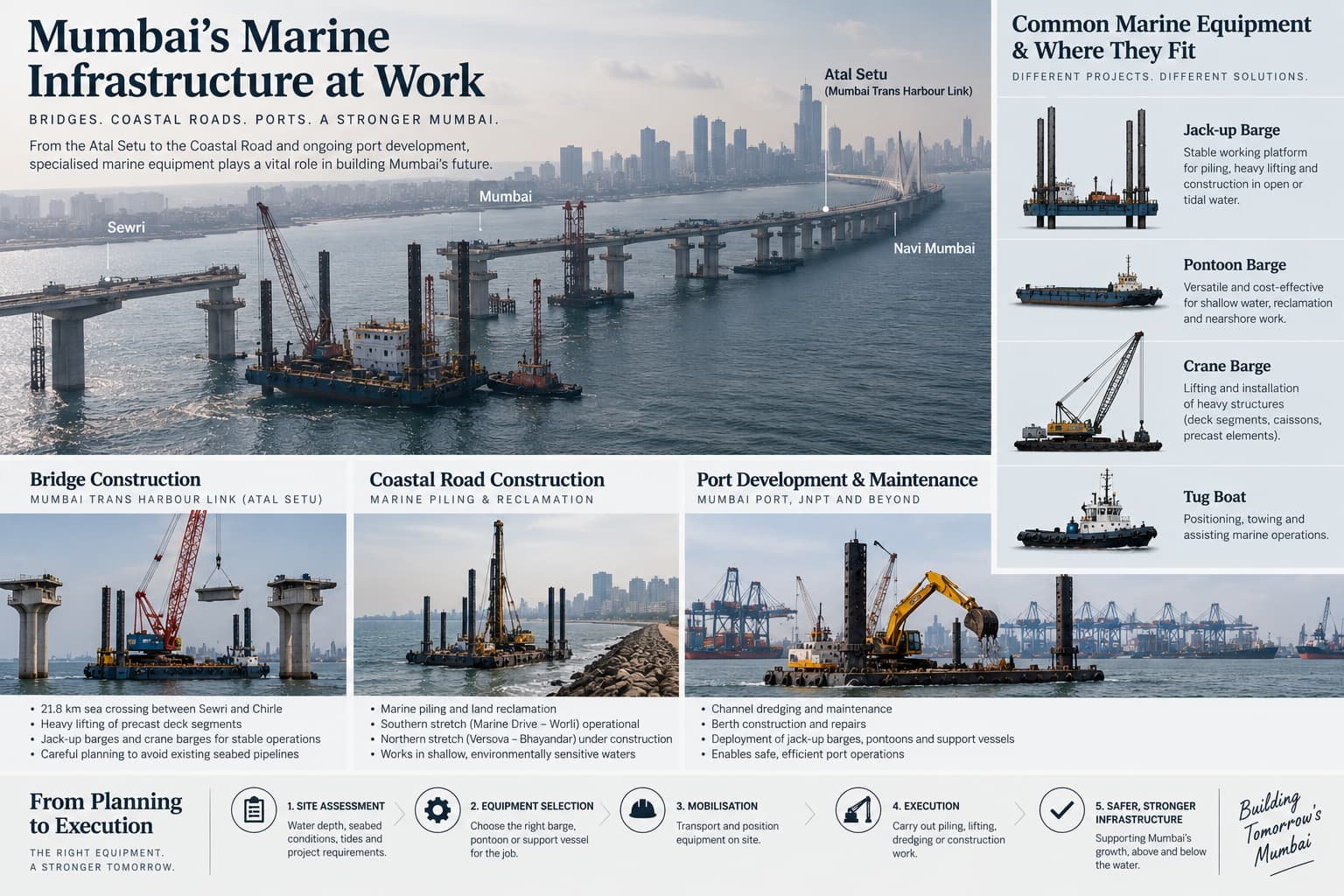
The Mumbai Trans Harbour Link, officially the Atal Setu, opened in January 2024 after running its marine construction in two major packages across the 21.8 km crossing between Sewri and Chirle. The project’s marine contractors used some of the largest specialised barges deployed in India for this kind of work, including a purpose-built barge used to lift and position prefabricated steel deck sections while avoiding existing seabed pipelines along the route.
What makes a project like this relevant to jack-up and pontoon operators generally, beyond its scale, is the pattern it set. Heavy deck sections and bridge piers need a stable platform to work from across open, tidal water, and that’s precisely the gap a jacked-up or securely moored barge fills. Smaller marine infrastructure jobs across the harbour use the same basic approach at a different scale.
Coastal road construction: piling and reclamation
Mumbai’s Coastal Road project illustrates a different application. Its southern stretch, from Marine Drive to Worli, has been operational in phases since 2024, while the northern Versova to Bhayandar extension began full-scale construction in early 2026 after clearing a mangrove protection permit. That northern stretch runs through significant Coastal Regulation Zone area and requires extensive reclamation and marine piling work along its alignment.
Reclamation and piling work like this typically needs a stable platform positioned close to shore in shallow, often environmentally sensitive water, which tends to favour pontoons and jack-up barges with a shallower draft over larger, deeper-draft vessels. Site access in these conditions is often the deciding factor in equipment choice, more so than deck load capacity alone.
What this means for equipment choice on a Mumbai project
Looking at these projects side by side makes the underlying pattern clearer: the type of marine work decides the type of barge, and Mumbai’s mix of project types means a single fleet rarely does everything.
Matching barge type to project type
| Project type | Typical equipment role | Key site factor |
|---|---|---|
| Bridge piling and pier construction | Stable platform for piling rigs and heavy lift cranes over open tidal water | Water depth, current strength, seabed bearing capacity |
| Coastal road piling and reclamation | Shallow-draft platform working close to shore in CRZ areas | Restricted access, environmental clearance conditions |
| Port channel maintenance dredging | Support platform and equipment transport for dredging operations | Ongoing vessel traffic, seasonal siltation |
| Jetty and harbour wall repair | Fixed, stable deck for repair crews and equipment close to an existing structure | Limited manoeuvring space, structure proximity |
Site access in restricted or sensitive waters
Several of Mumbai’s current and recent projects run through areas with real environmental sensitivity, from mangrove-protected stretches on the Coastal Road’s northern extension to the flamingo habitat the Trans Harbour Link’s design had to account for. For a jack-up barge or pontoon operator, that sensitivity usually translates into narrower work windows, additional clearance requirements before mobilisation, and a stronger case for modular units that can reach a restricted site in sections rather than as a single large hull, the same trade-off covered in our guide comparing jack-up and modular jack-up barges.
Port channel work: a different kind of ongoing demand
Unlike a bridge or road project with a defined start and end, maintenance dredging at Mumbai’s port channels runs on a recurring cycle because of continuous siltation, the same factor covered in our guide on Mumbai harbour conditions. That recurring need creates steadier, longer-term demand for support barges and equipment transport than a single infrastructure project does, even if the individual jobs are smaller in scale.
What this pipeline means for Mumbai-based fleet operators
Taken together, these projects show why a fleet based in Mumbai benefits from carrying more than one type of jack-up or pontoon unit, rather than standardising on a single design. A conventional jack-up barge suits a job with straightforward access and fast turnaround. A modular unit earns its place on a restricted or environmentally sensitive site. A flat top pontoon may be the better fit for equipment transport and support roles around an active channel.
FDC maintains exactly this kind of mixed fleet from its Mumbai base, including conventional unit AQUAQUEEN and modular units AMIT, PRIDE 1, SANGAM 2 and AQUASTAR, supported by an in-house shipyard in Belapur, Navi Mumbai for modification and repair work suited to a specific project’s requirements. For guidance on equipment suited to a particular site or project type, call 98677 00755 / 93218 44408 or email famous2131@gmail.com.
Leave a Reply