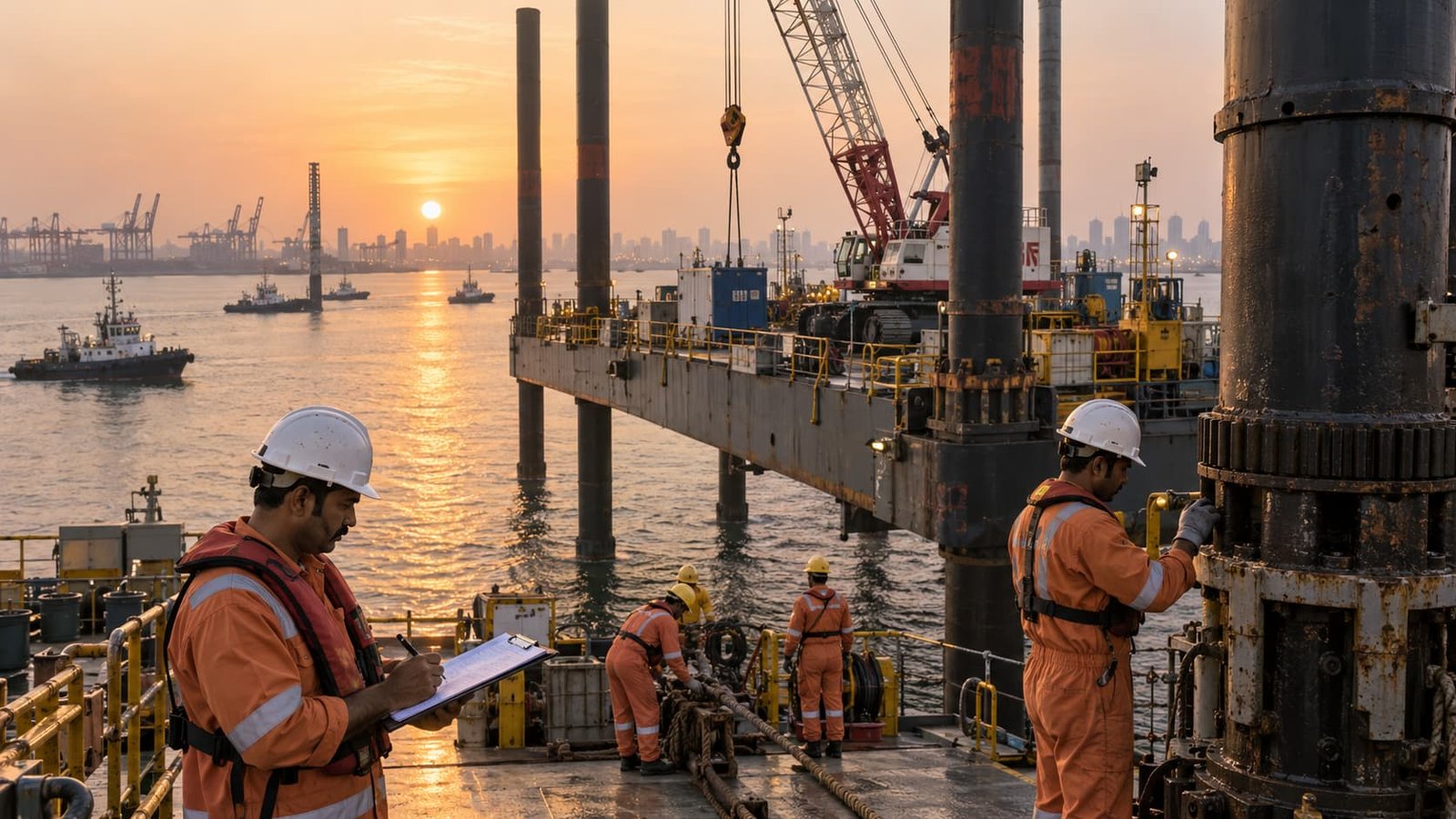
Nobody becomes a jack-up barge technician for the paperwork, yet the paperwork is exactly what separates a routine day from an incident. Between the first muster before sunrise and the final sign-off after dark, the job is really a long run of small checks, each one unglamorous on its own, that together keep a few hundred tonnes of steel standing safely above the water.
This isn’t any one person’s account, it’s a composite of what a working day on a jack-up barge in Mumbai actually involves, pulling together the jacking, preload, maintenance and crew procedures covered elsewhere in this series. If any of the steps mentioned here feel unfamiliar, our guides on how a jack-up barge works covers it in more depth.
Before sunrise: muster and the first checks of the day
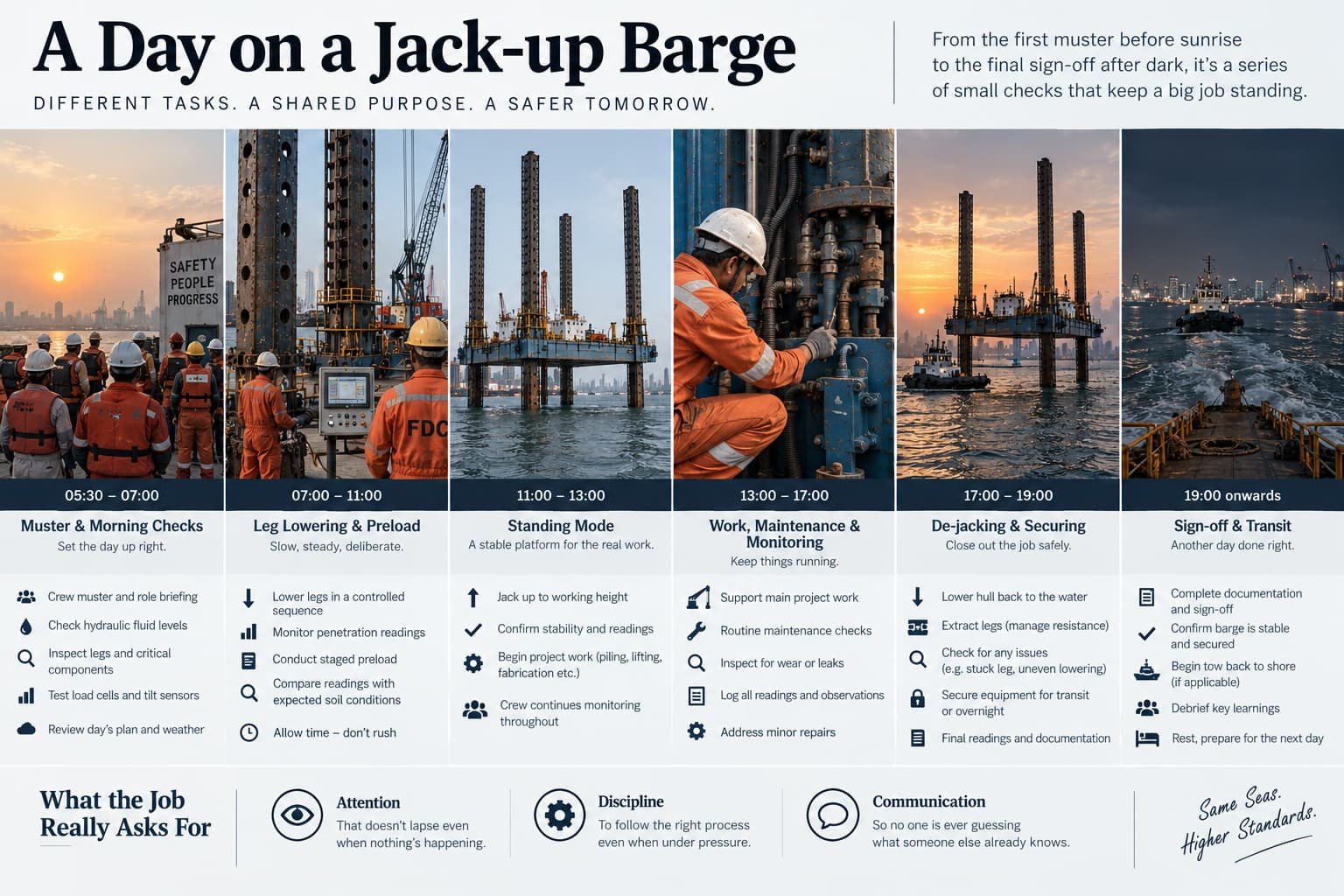
The day starts before the sun’s properly up, usually with a muster on deck while the harbour is still quiet enough to hear the water against the hull. This first gathering isn’t ceremonial. It’s where the person in charge confirms who’s covering which role for the day, a conversation that matters more on a jack-up barge than on most vessels, since a jacking operation depends on every role being clearly assigned before anyone touches the controls.
While the briefing runs, someone’s usually already moving through the first physical checks: hydraulic fluid levels, a visual pass over the legs for anything that looks different from yesterday, and a function test on the load cells and tilt sensors that the whole crew will be relying on once jacking starts. None of this takes long individually. Together, it’s the difference between starting the day with confidence in the equipment and starting it hoping everything’s still fine.
Mid-morning: getting the legs down and starting preload
Once the barge is positioned, the legs start lowering, and this is where the day’s pace changes from brisk to deliberate. Watching a leg descend doesn’t look like much from the deck, but the person tracking penetration readings is doing some of the most important work of the whole day, comparing how each leg is behaving against what the site’s soil conditions would predict.
Preload comes next, and it’s the part of the job that tests patience more than skill. Ballasting in stages, holding, checking penetration, ballasting again, the whole sequence can take a couple of hours on a cautious site. It’s tempting, especially under schedule pressure, to rush through the stages. The technicians who’ve been doing this longest are usually the ones most comfortable slowing down here, because they’ve seen what happens when someone doesn’t.
Midday: standing mode and deck work
Once preload holds and the barge jacks up fully, the mood on deck shifts noticeably. Standing on a jacked-up barge feels different from standing on a floating one, steadier, quieter, almost like solid ground, and this is when the actual job the barge was brought out for gets underway. Depending on the project, that might mean supporting a piling rig, positioning a crane for a lift, or providing a stable platform for fabrication work.
For the crew not directly involved in the day’s main task, standing mode doesn’t mean standing around. This is often when routine maintenance checks happen, since the legs and jacking system are under working load and any developing issue is more likely to show itself now than when the barge is idle.
When the day doesn’t go to plan
Most days on a jack-up barge are genuinely routine, which is exactly the point of good procedure. But every technician on this job eventually has a day where something doesn’t go as expected, and how that day unfolds says more about the crew than any of the quiet, uneventful ones.
Maybe it’s a leg that penetrates faster than its neighbours during preload, maybe it’s a weather update that arrives mid-afternoon with conditions closing in faster than forecast, particularly a real possibility during Mumbai’s monsoon months. Whatever the specific trigger, the response looks the same: someone notices, someone says so clearly, and the person in charge makes the call to pause rather than push through. The technicians who’ve been doing this a while describe these moments less as emergencies and more as the job working exactly as it’s supposed to.
Afternoon: the unglamorous work that keeps everything running
By mid-afternoon, the adrenaline of the morning’s jacking operation has usually settled into something closer to routine maintenance and documentation. This is when the day’s readings get logged properly rather than just observed and moved past, a habit that matters more than it feels like it does in the moment, since next month’s crew will be reading today’s notes trying to understand how this specific site behaves.
It’s also often when smaller repairs happen, a pin that needed a bit more force than usual gets flagged for a closer look, a hydraulic top-up gets recorded against last week’s reading rather than treated as a one-off. None of this is dramatic. All of it is the actual substance of keeping a jacking system reliable over years of service rather than months.
Evening: de-jacking and heading home
As the light starts to go, attention turns to closing out the day. If the job’s complete, that means de-jacking, lowering the hull back into the water and working the legs free of the seabed, a process that can be entirely routine or can turn into the longest hour of the day if a leg has settled in more firmly than expected after standing for weeks.
Sign-off happens once the barge is confirmed stable and secured for the night or for transit. It’s a small, almost administrative moment, a final confirmation that the readings are where they should be and the day’s events are documented, but it’s the moment that actually closes the loop on everything that happened since the morning muster. Then, finally, there’s the trip back to shore, usually in the kind of quiet that only comes after a day spent paying close attention to things most people never think about.
What the job actually asks of you
Strip away the specific tasks and a jack-up barge technician’s day really asks for three things: attention that doesn’t lapse even when nothing’s happening, the discipline to follow a slow procedure when every instinct says to speed up, and enough communication with the rest of the crew that nobody’s ever guessing what someone else already knows. None of that shows up on a job description, but it’s most of what the work actually is.
FDC’s crews across AQUAQUEEN, AMIT, PRIDE 1, SANGAM 2 and AQUASTAR work days shaped by exactly this routine, supported by an in-house shipyard in Belapur, Navi Mumbai that keeps the jacking systems these days depend on in working order. For more on life and work aboard FDC’s fleet, call 98677 00755 / 93218 44408 or email famous2131@gmail.com.
Leave a Reply