Author: Onkar

  • A day in the life of a jack-up barge technician

    A day in the life of a jack-up barge technician

    Nobody becomes a jack-up barge technician for the paperwork, yet the paperwork is exactly what separates a routine day from an incident. Between the first muster before sunrise and the final sign-off after dark, the job is really a long run of small checks, each one unglamorous on its own, that together keep a few hundred tonnes of steel standing safely above the water.

    This isn’t any one person’s account, it’s a composite of what a working day on a jack-up barge in Mumbai actually involves, pulling together the jacking, preload, maintenance and crew procedures covered elsewhere in this series. If any of the steps mentioned here feel unfamiliar, our guides on how a jack-up barge works covers it in more depth.

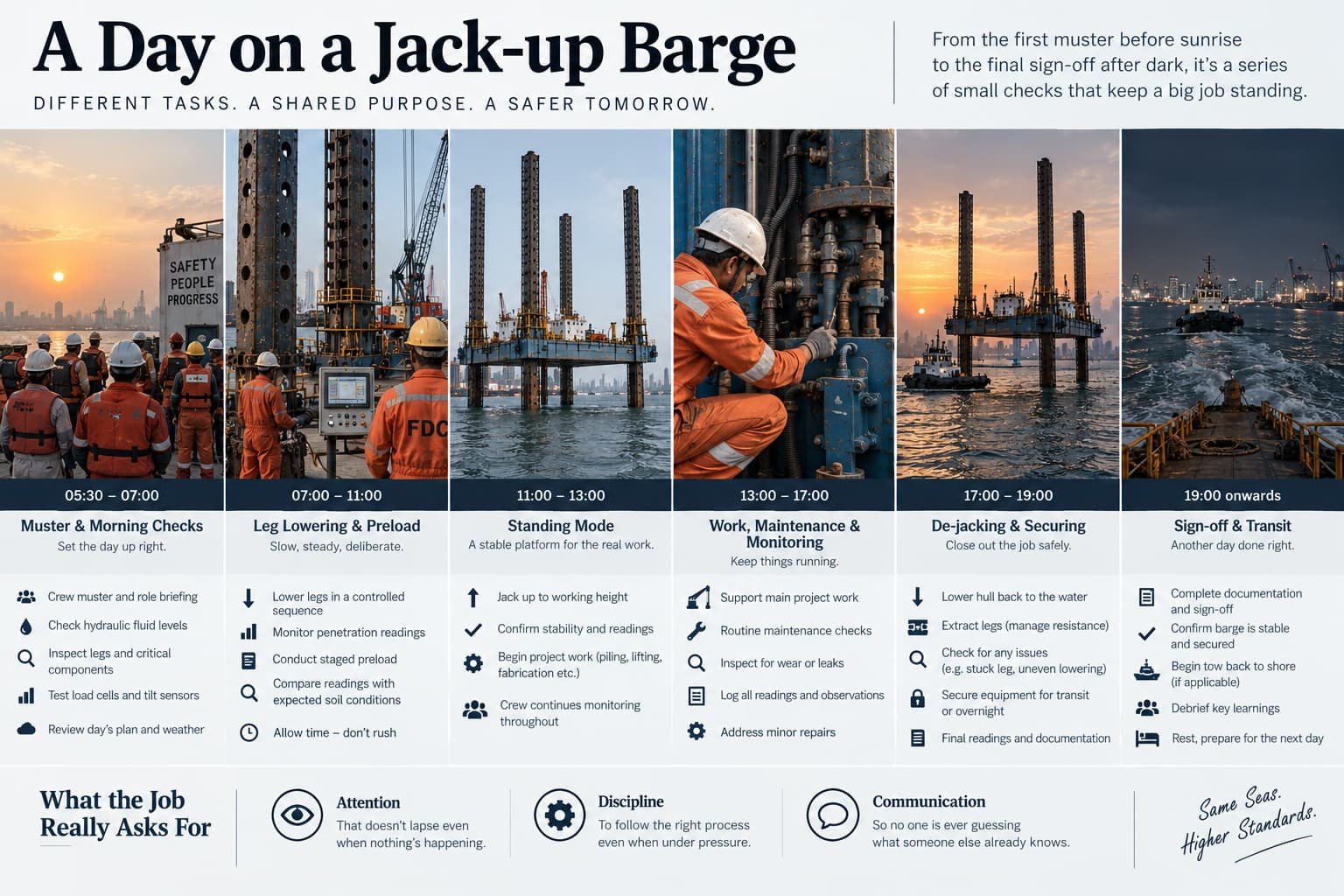
    Before sunrise: muster and the first checks of the day

    The day starts before the sun’s properly up, usually with a muster on deck while the harbour is still quiet enough to hear the water against the hull. This first gathering isn’t ceremonial. It’s where the person in charge confirms who’s covering which role for the day, a conversation that matters more on a jack-up barge than on most vessels, since a jacking operation depends on every role being clearly assigned before anyone touches the controls.

    While the briefing runs, someone’s usually already moving through the first physical checks: hydraulic fluid levels, a visual pass over the legs for anything that looks different from yesterday, and a function test on the load cells and tilt sensors that the whole crew will be relying on once jacking starts. None of this takes long individually. Together, it’s the difference between starting the day with confidence in the equipment and starting it hoping everything’s still fine.

    Mid-morning: getting the legs down and starting preload

    Once the barge is positioned, the legs start lowering, and this is where the day’s pace changes from brisk to deliberate. Watching a leg descend doesn’t look like much from the deck, but the person tracking penetration readings is doing some of the most important work of the whole day, comparing how each leg is behaving against what the site’s soil conditions would predict.

    Preload comes next, and it’s the part of the job that tests patience more than skill. Ballasting in stages, holding, checking penetration, ballasting again, the whole sequence can take a couple of hours on a cautious site. It’s tempting, especially under schedule pressure, to rush through the stages. The technicians who’ve been doing this longest are usually the ones most comfortable slowing down here, because they’ve seen what happens when someone doesn’t.

    Midday: standing mode and deck work

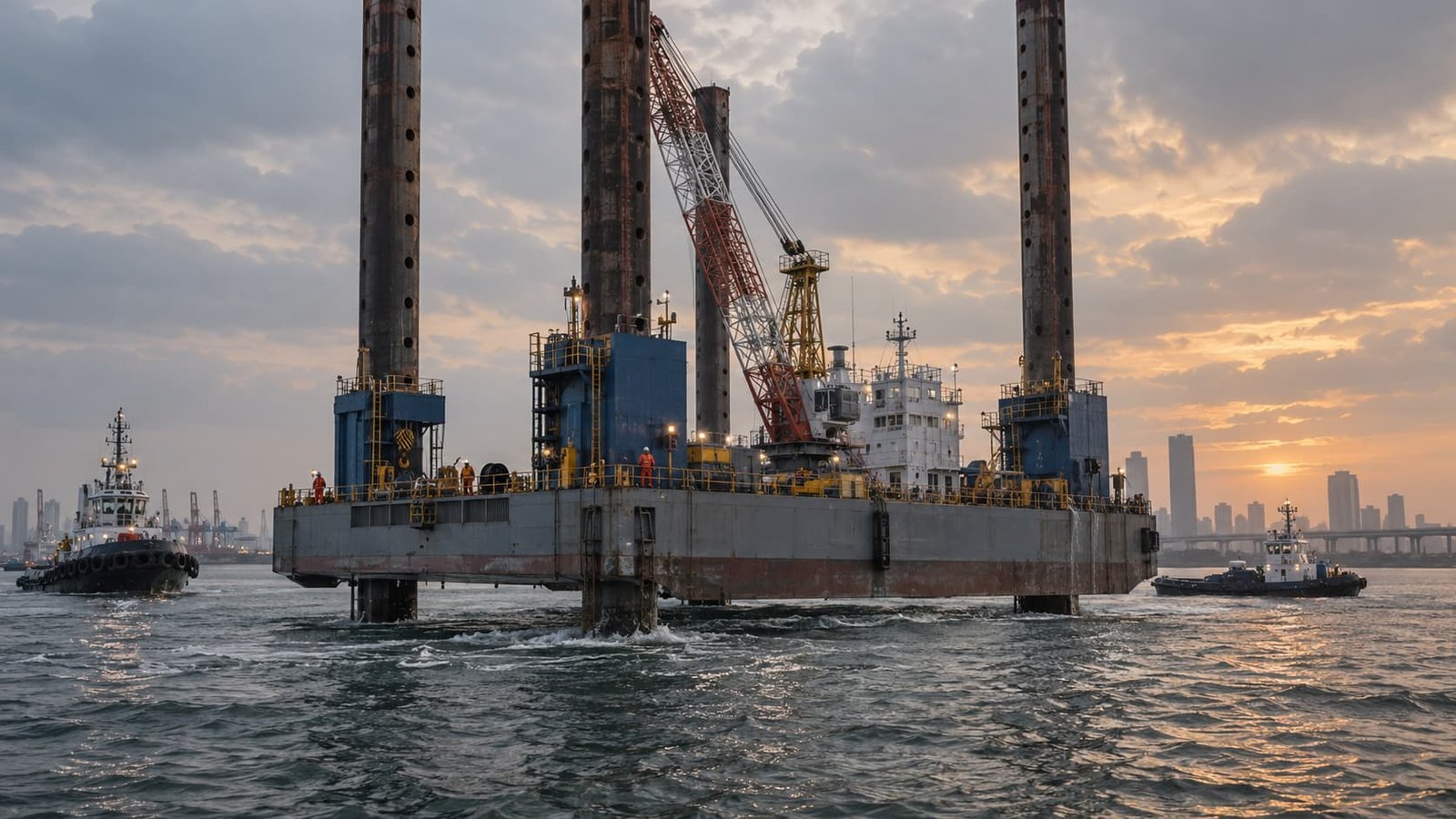
    Once preload holds and the barge jacks up fully, the mood on deck shifts noticeably. Standing on a jacked-up barge feels different from standing on a floating one, steadier, quieter, almost like solid ground, and this is when the actual job the barge was brought out for gets underway. Depending on the project, that might mean supporting a piling rig, positioning a crane for a lift, or providing a stable platform for fabrication work.

    For the crew not directly involved in the day’s main task, standing mode doesn’t mean standing around. This is often when routine maintenance checks happen, since the legs and jacking system are under working load and any developing issue is more likely to show itself now than when the barge is idle.
    day-in-the-life-of-jack-up-barge-technician

    When the day doesn’t go to plan

    Most days on a jack-up barge are genuinely routine, which is exactly the point of good procedure. But every technician on this job eventually has a day where something doesn’t go as expected, and how that day unfolds says more about the crew than any of the quiet, uneventful ones.

    Maybe it’s a leg that penetrates faster than its neighbours during preload, maybe it’s a weather update that arrives mid-afternoon with conditions closing in faster than forecast, particularly a real possibility during Mumbai’s monsoon months. Whatever the specific trigger, the response looks the same: someone notices, someone says so clearly, and the person in charge makes the call to pause rather than push through. The technicians who’ve been doing this a while describe these moments less as emergencies and more as the job working exactly as it’s supposed to.

    Afternoon: the unglamorous work that keeps everything running

    By mid-afternoon, the adrenaline of the morning’s jacking operation has usually settled into something closer to routine maintenance and documentation. This is when the day’s readings get logged properly rather than just observed and moved past, a habit that matters more than it feels like it does in the moment, since next month’s crew will be reading today’s notes trying to understand how this specific site behaves.

    It’s also often when smaller repairs happen, a pin that needed a bit more force than usual gets flagged for a closer look, a hydraulic top-up gets recorded against last week’s reading rather than treated as a one-off. None of this is dramatic. All of it is the actual substance of keeping a jacking system reliable over years of service rather than months.

    Evening: de-jacking and heading home

    As the light starts to go, attention turns to closing out the day. If the job’s complete, that means de-jacking, lowering the hull back into the water and working the legs free of the seabed, a process that can be entirely routine or can turn into the longest hour of the day if a leg has settled in more firmly than expected after standing for weeks.

    Sign-off happens once the barge is confirmed stable and secured for the night or for transit. It’s a small, almost administrative moment, a final confirmation that the readings are where they should be and the day’s events are documented, but it’s the moment that actually closes the loop on everything that happened since the morning muster. Then, finally, there’s the trip back to shore, usually in the kind of quiet that only comes after a day spent paying close attention to things most people never think about.

    What the job actually asks of you

    Strip away the specific tasks and a jack-up barge technician’s day really asks for three things: attention that doesn’t lapse even when nothing’s happening, the discipline to follow a slow procedure when every instinct says to speed up, and enough communication with the rest of the crew that nobody’s ever guessing what someone else already knows. None of that shows up on a job description, but it’s most of what the work actually is.

    FDC’s crews across AQUAQUEEN, AMIT, PRIDE 1, SANGAM 2 and AQUASTAR work days shaped by exactly this routine, supported by an in-house shipyard in Belapur, Navi Mumbai that keeps the jacking systems these days depend on in working order. For more on life and work aboard FDC’s fleet, call 98677 00755 / 93218 44408 or email famous2131@gmail.com.
  • Jack-up barge de-jacking and emergency procedures: What to do when it doesn’t go to plan

    Jack-up barge de-jacking and emergency procedures: What to do when it doesn’t go to plan

    De-jacking gets treated as the easy half of the job because it looks like jacking up run backward. It isn’t. A leg that sank cleanly into soft seabed during arrival doesn’t always come out as cleanly, and a crew that’s already mentally moved on to the tow home is exactly the crew least prepared for a leg that won’t release.

    This guide covers how de-jacking actually works, what to check before starting it, and how to respond when the sequence doesn’t go to plan. It follows on from our guides on how a jack-up barge works and jack-up barge preload, which this builds on directly.

    Why de-jacking isn’t just jacking up in reverse

    Jacking up deals with resistance you can plan for in advance: you know roughly what the seabed will offer before the legs go down, and preload tests that resistance deliberately. De-jacking deals with a different problem, because by this point the legs have been sitting in the seabed for the duration of the job, sometimes for weeks, and the soil around them has had time to consolidate and grip the leg more tightly than it did on arrival.

    That grip, sometimes called suction or adhesion depending on the soil type, can resist leg extraction with a force that has little to do with how easily the leg went in. A leg that penetrated smoothly during preload can still require significantly more force to pull free during de-jacking, particularly after an extended job in clay or silt.

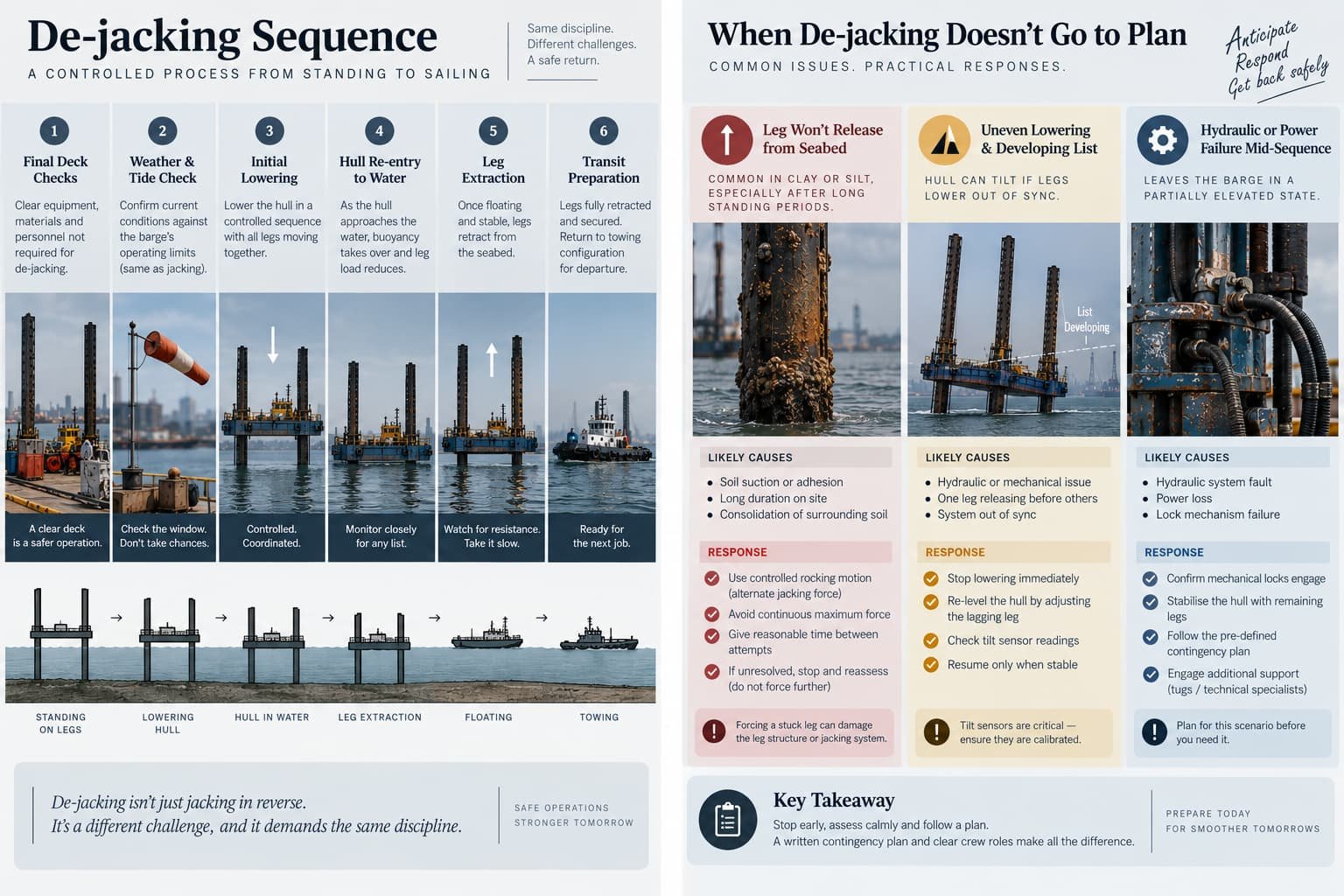
    The de-jacking sequence step by step

    jack-up-barge-de-jacking

    1. Final deck checks. Confirm all equipment, materials and personnel not required for the de-jacking operation are cleared from the deck, since the hull’s behaviour during lowering is less predictable than during stable standing mode.
    2. Weather and tide check. Confirm current conditions against the same limits used for jacking up, since lowering into open water carries the same current and wind exposure risks as the original leg lowering did.
    3. Initial lowering. The jacking system lowers the hull back down the legs in a controlled sequence, with all legs moving in coordination rather than independently.
    4. Hull re-entry to the water. As the hull approaches the water, buoyancy begins to take over from the legs, and load on the legs decreases correspondingly. This transition needs close monitoring, since an uneven transition can tilt the hull before it’s fully supported by buoyancy.
    5. Leg extraction. Once the hull is floating and stable, the legs retract from the seabed. This is where suction resistance shows up most clearly, and where the sequence most often needs to pause and reassess.
    6. Transit preparation. With legs fully retracted and secured, the barge returns to its towing configuration for departure.

    What to check before starting de-jacking

    • Soil type and how long the legs have been standing, since both affect expected extraction resistance
    • Hydraulic or rack and pinion system condition, confirmed fit for a full lowering cycle
    • Weather window checked against the barge’s stated limits, the same as for the original jacking operation
    • Tug availability confirmed for departure once the barge is back in floating mode
    • Deck cleared and crew positions assigned for the lowering sequence

    When de-jacking doesn’t go to plan

    Most de-jacking operations complete without incident, but the failure modes that do occur tend to be specific and recognisable, which makes knowing them in advance the most useful preparation a crew can have.

    A leg that won’t release from the seabed

    This is the most common de-jacking complication, particularly after a longer job in clay or fine silt. The leg has penetrated and consolidated into the soil, and simple upward force from the jacking system isn’t overcoming the suction holding it in place.

    The response here is patience over force. Applying maximum jacking force to break a stuck leg risks damaging the leg structure or the jacking system itself before it succeeds in freeing the leg. A controlled rocking motion, alternating slight increases and decreases in jacking force, often breaks the suction more effectively and more safely than sustained maximum force. If the leg still won’t release after a reasonable number of attempts, the crew needs to stop and reassess rather than continuing to force it, since continued forcing is exactly how legs and jacking components get damaged.

    Uneven lowering and developing list

    If one leg lowers out of sync with the others, whether due to a hydraulic fault, a mechanical issue, or one leg releasing from the seabed before the others, the hull can develop a list during the transition between standing and floating mode. Tilt sensors should catch this early, which is exactly why their calibration, covered in our maintenance guide, matters as much during de-jacking as during jacking up.

    The correct response is to stop the lowering sequence immediately once a list develops, rather than continuing and hoping the other legs catch up. Re-level the hull by adjusting the lagging leg’s position before resuming, even if that means the overall sequence takes longer than planned.

    Hydraulic or power failure mid-sequence

    A hydraulic failure partway through de-jacking leaves the barge in a partially elevated, partially supported state, which is one of the more serious situations a jacking system can present. Most systems include a mechanical locking feature that holds leg position if hydraulic pressure is lost, and confirming this lock engages correctly is exactly why the pre-de-jacking hydraulic check matters.

    If a lock failure leaves a leg unsupported during a power loss, the priority becomes stabilising the hull using whatever legs remain under control, rather than attempting to continue the full sequence on a partial system. This is a scenario worth planning for explicitly rather than improvising in the moment, since the right first move depends on which legs are affected and how the specific jacking system’s lock mechanism behaves.

    Building an emergency response plan before you need one

    The common thread across all three scenarios above is that the right response depends on recognising the problem early and stopping rather than pushing through on the assumption it will resolve itself. A written contingency plan, agreed before the job starts rather than improvised during an incident, should define who makes the call to stop, what the escalation path looks like, and which external support, additional tugs, technical specialists, or classification society notification, gets triggered at what stage.

    Crew roles matter here as much as the technical steps. Everyone on deck during de-jacking should know in advance who’s watching tilt readings, who’s monitoring leg load, and who has authority to halt the sequence, rather than that clarity being worked out in real time during an actual problem.

    Documenting a de-jacking incident

    Any de-jacking operation that departs from a smooth, routine sequence is worth recording in detail, including leg loads, timing, and the specific response taken, regardless of whether the situation ultimately resolved without damage. This record serves two purposes: it gives the next crew working that same site useful data on what to expect from that location’s soil, and it provides the documentation a classification society survey may ask for if the incident affected jacking system components.

    A pre-de-jacking checklist

    • Soil type and standing duration reviewed to anticipate extraction resistance
    • Hydraulic lock mechanism confirmed functional before starting
    • Weather and tide window checked against the barge’s stated limits
    • Crew roles and stop authority agreed before lowering begins
    • Tug support confirmed and on standby for departure
    • Contingency plan reviewed for stuck leg, uneven lowering and power failure scenarios

    FDC’s fleet, including AQUAQUEEN, AMIT, PRIDE 1, SANGAM 2 and AQUASTAR, is maintained through its in-house shipyard in Belapur, Navi Mumbai, with jacking system and hydraulic lock checks built into the fleet’s standard maintenance routine. For technical support on a de-jacking plan or an active jacking system issue, call 98677 00755 / 93218 44408 or email famous2131@gmail.com.
  • Jack-up barges in Mumbai: From bridge piling to port channel work

    Jack-up barges in Mumbai: From bridge piling to port channel work

    Most people who drive across the Atal Setu or along the Coastal Road never think about what held the construction crew steady while the sea moved beneath them. For the technicians who built it, that question decided which piece of equipment got deployed on which stretch of the job.

    Mumbai’s marine infrastructure pipeline, bridges, coastal roads, port channel maintenance, gives a useful real-world view of where jack-up barges, pontoons and other specialised marine equipment actually get used, and why one type of barge suits one project while a different job calls for something else entirely. This guide walks through that, building on our earlier guides on how a jack-up barge works and jack-up barge operations in Mumbai harbour.

    Why Mumbai generates so much of this kind of work

    Mumbai’s geography puts water in the middle of almost every major infrastructure decision the city makes. A harbour that splits the city from Navi Mumbai, a western coastline under active road development, and a port handling a significant share of India’s container traffic all require construction methods that work from the water rather than around it. That combination makes Mumbai one of the more active markets in India for jack-up barges, pontoons and the tugs that move them.

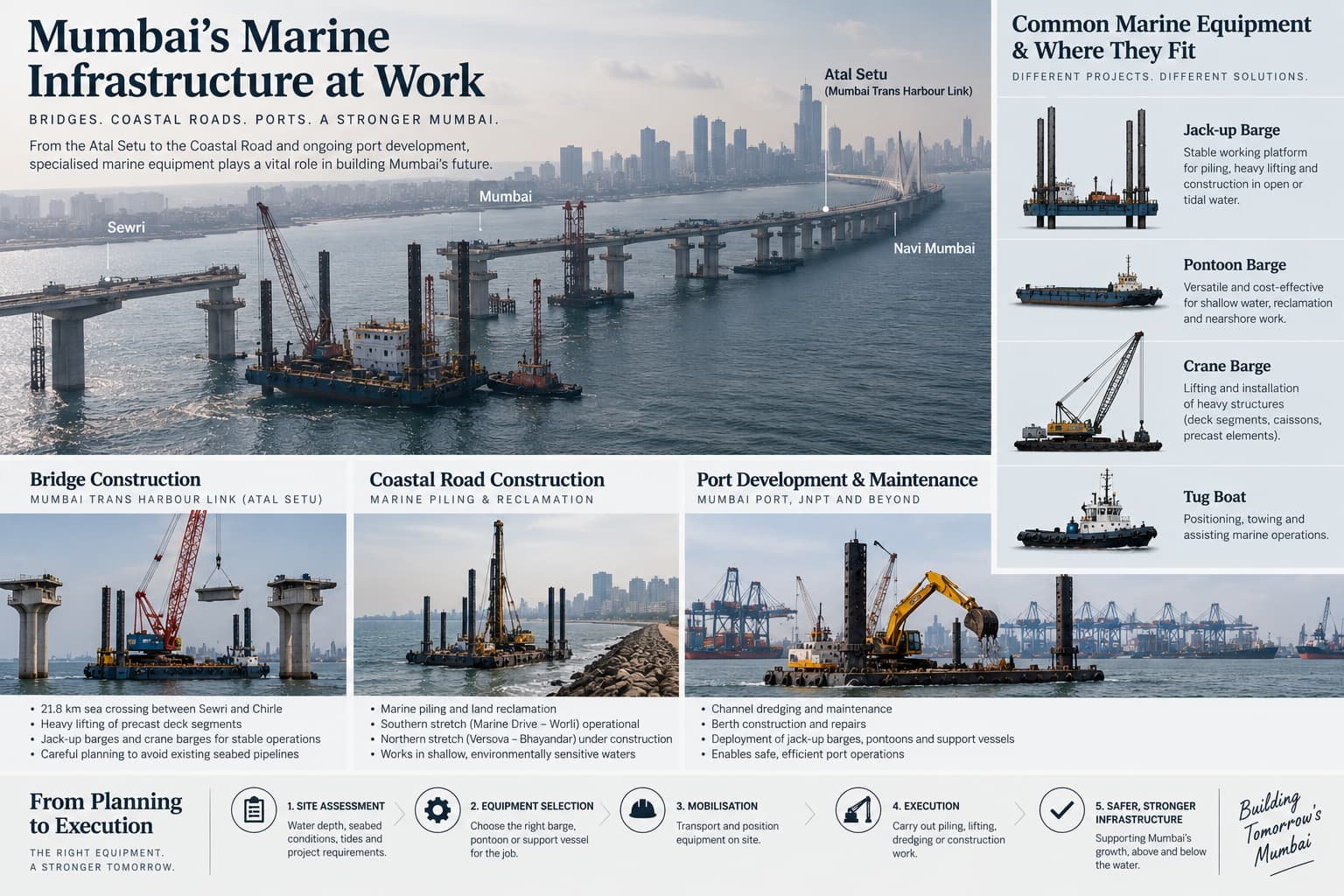
    Bridge construction: the Mumbai Trans Harbour Link example

    The Mumbai Trans Harbour Link, officially the Atal Setu, opened in January 2024 after running its marine construction in two major packages across the 21.8 km crossing between Sewri and Chirle. The project’s marine contractors used some of the largest specialised barges deployed in India for this kind of work, including a purpose-built barge used to lift and position prefabricated steel deck sections while avoiding existing seabed pipelines along the route.

    What makes a project like this relevant to jack-up and pontoon operators generally, beyond its scale, is the pattern it set. Heavy deck sections and bridge piers need a stable platform to work from across open, tidal water, and that’s precisely the gap a jacked-up or securely moored barge fills. Smaller marine infrastructure jobs across the harbour use the same basic approach at a different scale.

    Coastal road construction: piling and reclamation

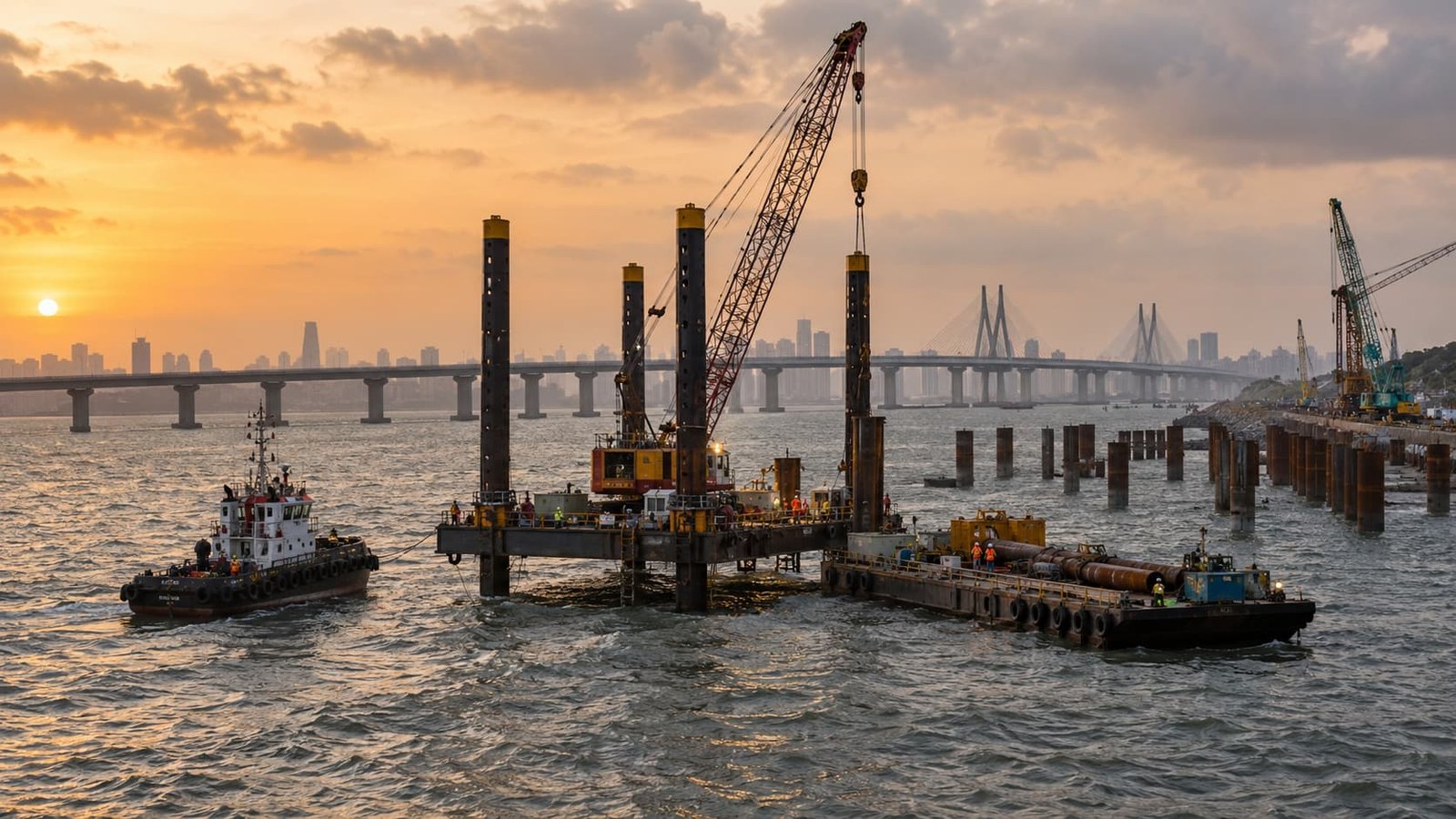
    Mumbai’s Coastal Road project illustrates a different application. Its southern stretch, from Marine Drive to Worli, has been operational in phases since 2024, while the northern Versova to Bhayandar extension began full-scale construction in early 2026 after clearing a mangrove protection permit. That northern stretch runs through significant Coastal Regulation Zone area and requires extensive reclamation and marine piling work along its alignment.

    Reclamation and piling work like this typically needs a stable platform positioned close to shore in shallow, often environmentally sensitive water, which tends to favour pontoons and jack-up barges with a shallower draft over larger, deeper-draft vessels. Site access in these conditions is often the deciding factor in equipment choice, more so than deck load capacity alone.

    jack-up-barge-work-mumbai

    What this means for equipment choice on a Mumbai project

    Looking at these projects side by side makes the underlying pattern clearer: the type of marine work decides the type of barge, and Mumbai’s mix of project types means a single fleet rarely does everything.

    Matching barge type to project type

    Project type Typical equipment role Key site factor
    Bridge piling and pier construction Stable platform for piling rigs and heavy lift cranes over open tidal water Water depth, current strength, seabed bearing capacity
    Coastal road piling and reclamation Shallow-draft platform working close to shore in CRZ areas Restricted access, environmental clearance conditions
    Port channel maintenance dredging Support platform and equipment transport for dredging operations Ongoing vessel traffic, seasonal siltation
    Jetty and harbour wall repair Fixed, stable deck for repair crews and equipment close to an existing structure Limited manoeuvring space, structure proximity

    Site access in restricted or sensitive waters

    Several of Mumbai’s current and recent projects run through areas with real environmental sensitivity, from mangrove-protected stretches on the Coastal Road’s northern extension to the flamingo habitat the Trans Harbour Link’s design had to account for. For a jack-up barge or pontoon operator, that sensitivity usually translates into narrower work windows, additional clearance requirements before mobilisation, and a stronger case for modular units that can reach a restricted site in sections rather than as a single large hull, the same trade-off covered in our guide comparing jack-up and modular jack-up barges.

    Port channel work: a different kind of ongoing demand

    Unlike a bridge or road project with a defined start and end, maintenance dredging at Mumbai’s port channels runs on a recurring cycle because of continuous siltation, the same factor covered in our guide on Mumbai harbour conditions. That recurring need creates steadier, longer-term demand for support barges and equipment transport than a single infrastructure project does, even if the individual jobs are smaller in scale.

    What this pipeline means for Mumbai-based fleet operators

    Taken together, these projects show why a fleet based in Mumbai benefits from carrying more than one type of jack-up or pontoon unit, rather than standardising on a single design. A conventional jack-up barge suits a job with straightforward access and fast turnaround. A modular unit earns its place on a restricted or environmentally sensitive site. A flat top pontoon may be the better fit for equipment transport and support roles around an active channel.

    FDC maintains exactly this kind of mixed fleet from its Mumbai base, including conventional unit AQUAQUEEN and modular units AMIT, PRIDE 1, SANGAM 2 and AQUASTAR, supported by an in-house shipyard in Belapur, Navi Mumbai for modification and repair work suited to a specific project’s requirements. For guidance on equipment suited to a particular site or project type, call 98677 00755 / 93218 44408 or email famous2131@gmail.com.
  • Jack-up barge operations in Mumbai harbour: Tides, monsoon and seabed conditions

    Jack-up barge operations in Mumbai harbour: Tides, monsoon and seabed conditions

    A jacking procedure that works perfectly in January can be the wrong call entirely by June. Mumbai’s harbour doesn’t just get wetter during the monsoon, it changes tidal behaviour, current strength and seabed conditions enough that a crew running on last season’s assumptions can find themselves caught out.

    This guide looks at what’s actually different about operating a jack-up barge in Mumbai specifically, covering tidal range, the monsoon working window, local seabed conditions and what that means for day to day planning. It builds on our earlier guides on how a jack-up barge works and jack-up barge preload, which this local context applies directly to.

    Why Mumbai’s harbour needs its own planning approach

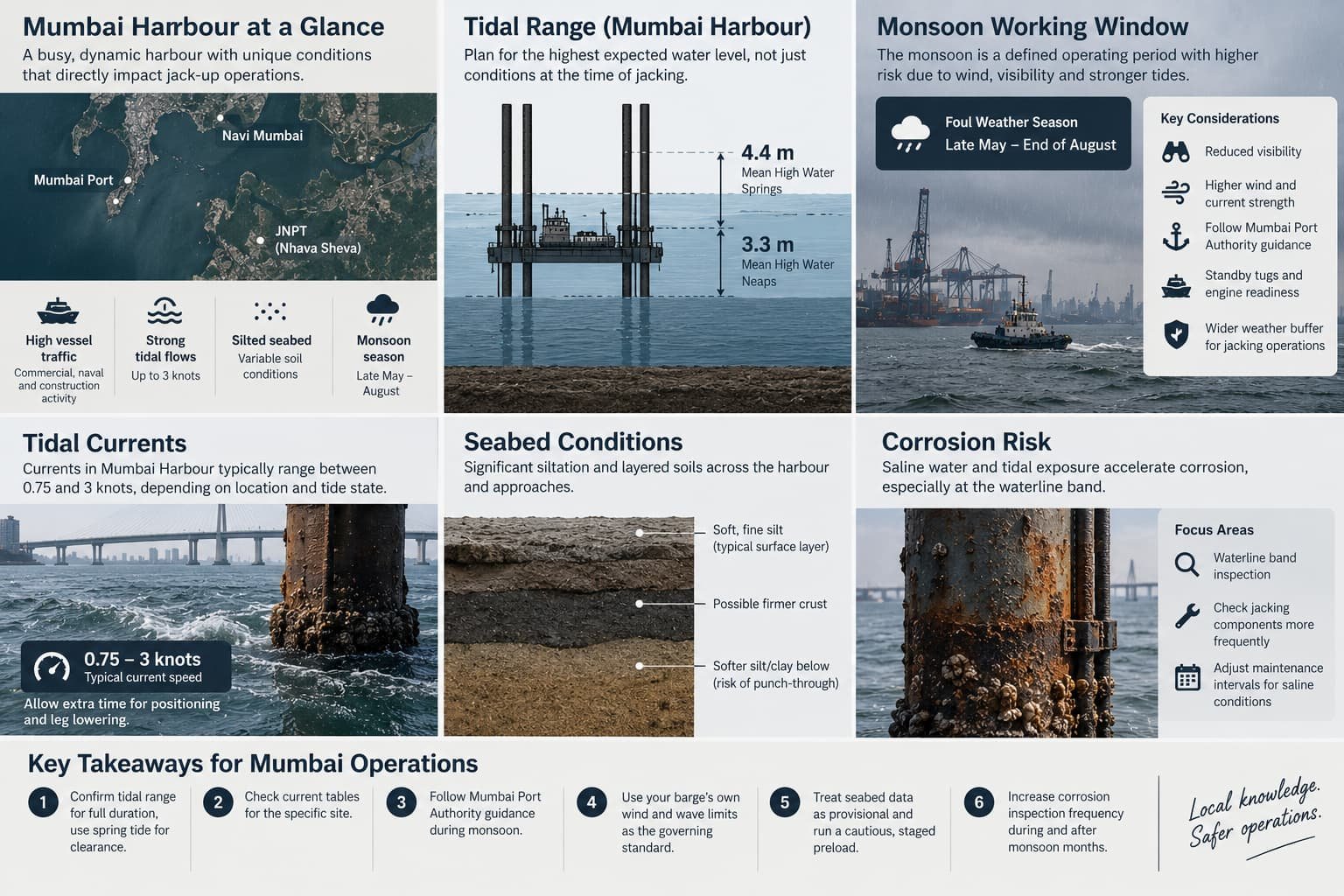
    Mumbai Harbour sits on India’s west coast and handles a mix of port traffic, naval activity and marine construction across Mumbai Port, Jawaharlal Nehru Port at Nhava Sheva, and the smaller creeks and jetties along Navi Mumbai and Thane. That mix means jacking operations here run alongside heavy vessel traffic, strong tidal flows and a seabed shaped by decades of siltation, none of which show up in a generic operating manual written for open water.

    Two factors do most of the work in making Mumbai distinct: the tidal range, which is large enough to matter for jacking clearance, and the monsoon, which doesn’t just bring rain but genuinely changes what’s safe to attempt on the water.

    Tidal range and what it means for jacking clearance

    Mumbai Harbour’s tidal rise reaches roughly 4.4 metres at mean high water springs and around 3.3 metres at mean high water neaps. That’s a substantial swing, and it directly affects how much air gap a jacked-up barge needs to clear the highest expected water level during a job, not just the water level at the moment jacking began.

    A barge jacked up during a neap tide and left standing into a spring tide cycle needs clearance calculated against the higher spring range, not the conditions present when the legs went down. Getting this wrong doesn’t cause an immediate problem the way punch-through does, but it erodes the safety margin the jacking plan was supposed to provide in the first place.

    Tidal currents and leg lowering

    Current speeds within Mumbai Harbour typically run between roughly 0.75 and 3 knots, depending on location and the state of the tide, and they’re strong enough to push on a barge’s legs while they’re being lowered, before the spud cans have found a stable footing. That lateral load during lowering is one of the failure modes we flagged in our guide on how a jack-up barge works, and it’s a genuinely local risk here rather than a generic caution, since Mumbai’s currents sit well above what a sheltered inland site would present.

    Positioning and holding the barge steady against this current before and during leg lowering matters more here than it would in calmer water, and it’s worth building extra time into the schedule for this step rather than treating it as routine.

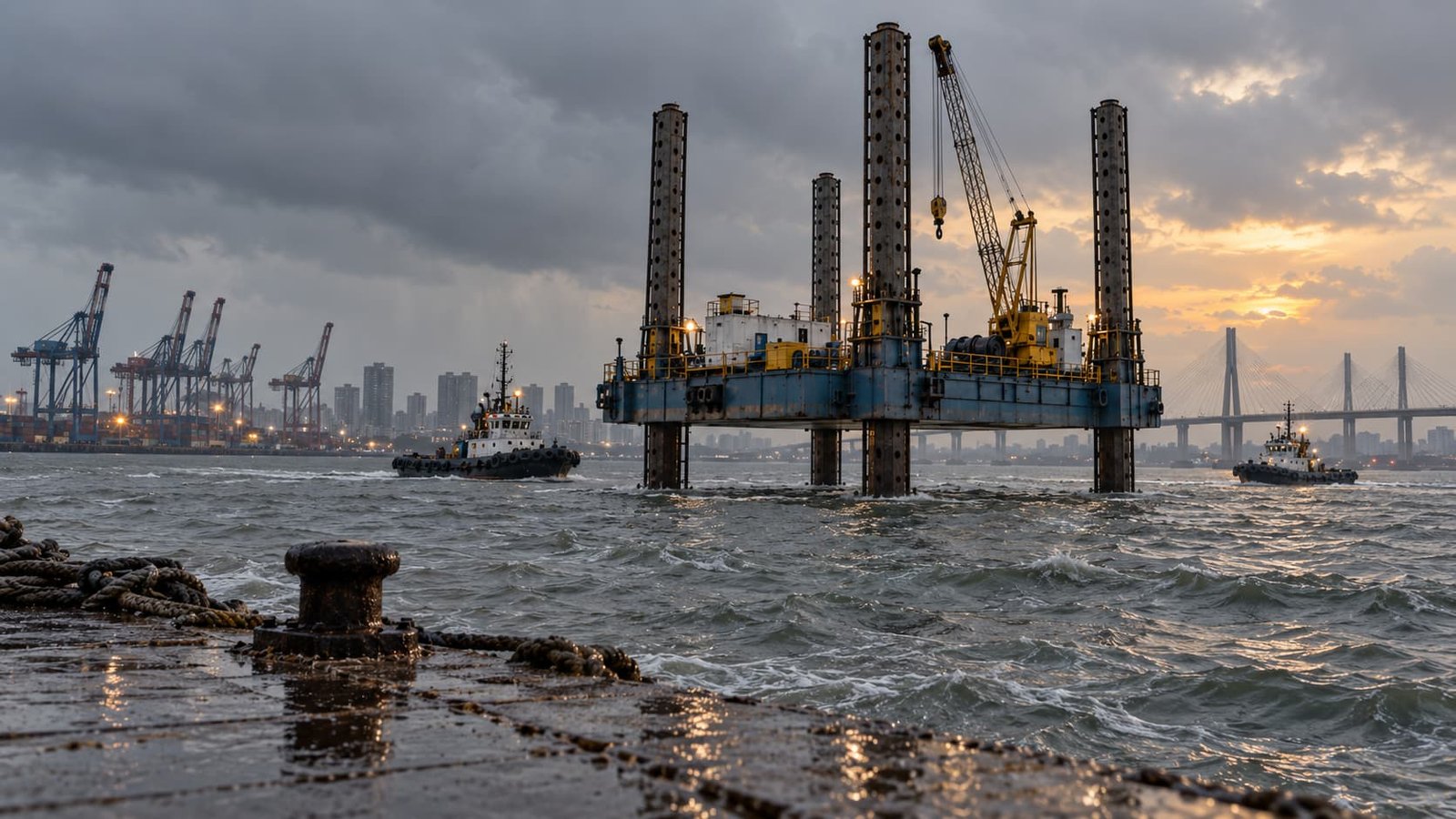
    jack-up-barge-Mumbai-harbour

    Planning jacking operations around Mumbai’s monsoon season

    Mumbai’s monsoon isn’t a minor seasonal inconvenience for marine work, it’s a defined operating period with its own guidance from the Mumbai Port Authority. The foul weather season typically runs from late May to the end of August, and during this window the harbour sees its strongest tides alongside greater wind and visibility risk.

    Port guidance during this period restricts anchorage to a defined foul weather limit line and calls for standby tugs, engine readiness and extra mooring provision for vessels in the harbour. None of that guidance is written specifically for jack-up barges, but the underlying caution applies just as directly: a jacking operation in reduced visibility, strong current and unpredictable wind carries meaningfully more risk than the same operation run in November.

    Reading harbour guidance against your own barge’s limits

    Port authority circulars set general vessel safety thresholds, not jacking-specific ones, so the right approach is to treat them as a floor rather than a complete answer. A barge’s own documented wave height and wind limits, set by its classification and design, should always be the stricter of the two during monsoon planning. If port guidance would allow an operation that exceeds your barge’s own stated limits, the barge’s limits govern, not the general circular.

    Practically, this means monsoon-season jacking in Mumbai needs a wider weather buffer than the same job planned for the post-monsoon working season, and a jacking schedule that assumes monsoon-season reliability equal to the rest of the year is planning against the wrong baseline.

    Seabed conditions across Mumbai’s harbour and approaches

    Mumbai’s harbour bed carries significant siltation, built up continuously by river discharge and tidal action, which is why maintenance dredging runs on a recurring schedule at berths and channels across the port rather than as a one-time job. For a jack-up barge, that siltation generally means a softer, finer-grained seabed than a crew might expect from a site further offshore, and it reinforces exactly the layered-soil risk covered in our guide on preload and punch-through.

    A crust of firmer material sitting over softer silt underneath is a realistic scenario at several points across the harbour and its approaches, which makes a careful, staged preload every bit as necessary here as the general guidance suggests, if not more so given how variable siltation depth can be between seasons.

    Corrosion in Mumbai’s saline harbour conditions

    We touched on saline corrosion in our maintenance guide, and Mumbai’s harbour is a direct example of the conditions that guidance was written for. Constant exposure to saline water, combined with the mechanical stress of tidal current on legs and jacking components, accelerates corrosion at the waterline band faster than fresh water conditions would. A maintenance interval copied from a manufacturer’s generic schedule, rather than adjusted for local saline exposure, risks missing corrosion that’s progressing faster than the schedule assumes.

    A seasonal checklist for Mumbai operations

    • Confirm the tidal range for the full duration the barge will stand jacked up, not just conditions at the time of jacking
    • Check current state tables for the specific berth or site, since velocity varies across the harbour
    • Cross-check planned operations against the current foul weather season dates and Mumbai Port Authority guidance
    • Apply your barge’s own documented wind and wave limits as the governing standard, especially during monsoon months
    • Treat seabed data as provisional where siltation is active, and budget extra time for a cautious, staged preload
    • Increase waterline corrosion inspection frequency during and after monsoon months rather than waiting for the standard interval

    FDC operates its fleet, including AQUAQUEEN, AMIT, PRIDE 1, SANGAM 2 and AQUASTAR, directly out of Mumbai, with crews and shipyard support in Belapur, Navi Mumbai familiar with these local tidal, seabed and seasonal conditions. For technical guidance on a specific site or job, call 98677 00755 / 93218 44408 or email famous2131@gmail.com.
  • Jack-up barge jacking system maintenance and inspection: What technicians need to check

    Jack-up barge jacking system maintenance and inspection: What technicians need to check

    A jacking system rarely fails without warning. It fails after weeks or months of small signs that nobody logged carefully enough to notice the pattern: a slightly slower jacking speed, a hydraulic top-up that happened more often than last month, a pin that needed a bit more persuasion to seat. None of those stop a job on their own, until the day they do.

    This guide sets out what to inspect on a jack-up barge jacking system, how often, and what early wear actually looks like before it becomes a breakdown. It builds on our guides on how a jack-up barge works and jack-up barge preload, which cover the mechanism and operation this maintenance keeps reliable.

    Why Jack up barge jacking system maintenance is different from general vessel maintenance

    Most marine maintenance deals with continuous wear: hull corrosion, engine hours, running gear. A jacking system wears differently, because its hardest-working components only move during the few hours of jacking up and jacking down on each job. That intermittent use means problems can sit undetected for a long time between inspections, since the pins, racks or hydraulic seals aren’t visibly in motion most of the time a barge is in service.

    It also means the stakes are higher than they first appear. A gradual engine problem usually gives a vessel time to limp to port. A jacking system fault during an actual jacking operation, with the hull partway between floating and standing, offers much less room to respond.

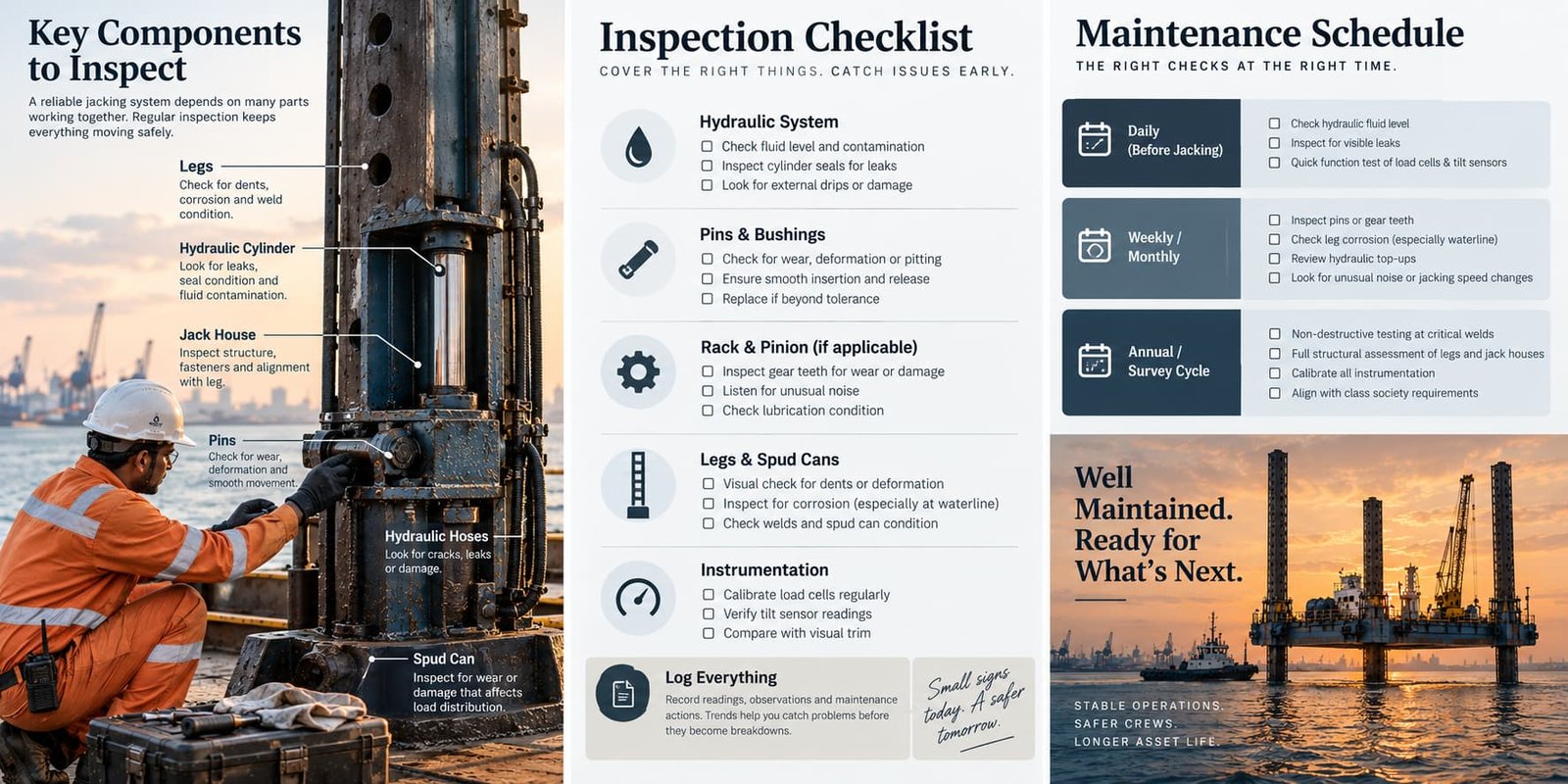
    What to inspect on a hydraulic jacking system

    Hydraulic pin and cylinder systems depend on seal integrity and fluid condition more than almost anything else. Technicians should check hydraulic fluid for contamination, since water ingress or metal particles in the fluid point to a seal or filtration problem developing elsewhere in the system. Cylinder seals themselves need a visual check for leakage at the rod, and any external drips noted during a previous jacking operation should be followed up specifically rather than assumed resolved.

    Pin condition matters just as much as the hydraulics driving them. Pins should move freely into their holes without excessive force, and any pin showing visible wear, deformation or surface pitting needs closer assessment before the next jacking operation, not after it.

    What to inspect on a rack and pinion jacking system

    Rack and pinion systems shift the inspection focus toward gear condition. Technicians should check rack and pinion teeth for wear patterns, pitting or chipping, since uneven tooth wear often signals a meshing or alignment problem rather than simple age. Motor and gearbox condition deserves the same attention, including listening for unusual noise during jacking operations, which frequently shows up before any visible wear does.

    Lubrication matters more here than on a hydraulic system, since dry or contaminated lubrication accelerates gear wear quickly. A lubrication schedule that’s followed consistently is one of the simplest ways to extend gear life on this type of system.

    Leg and structural inspection

    Check What it reveals
    Visual check for dents or deformation Impact damage that reduces a leg’s load-carrying capacity
    Corrosion inspection, especially at the waterline band Section loss that weakens the leg over time, worse in saline conditions
    Weld inspection at leg and spud can joints Fatigue cracking at high-stress connection points
    Non destructive testing at critical welds Subsurface cracking not visible to a routine visual check
    Spud can condition Wear or damage affecting how load spreads into the seabed

    Instrumentation: load cells and tilt sensors

    A jacking system is only as trustworthy as the readings a crew relies on during preload and jacking. Load cells measuring leg reaction force need periodic calibration against a known reference, since a drifted load cell can mask a genuine punch-through warning or, just as dangerously, trigger false alarms that crews start ignoring. Tilt sensors need the same discipline. A sensor reading a few degrees off during jacking can hide a real list developing in the hull until it’s visible to the eye, well past the point an accurate sensor would have flagged it.

    Building a maintenance schedule that actually gets followed

    None of the checks above help much if they exist only as a policy document nobody consults. A schedule that survives contact with a busy job calendar needs to be realistic about what gets checked when.

    Setting inspection intervals

    Daily checks before any jacking operation should cover hydraulic fluid level, visible leaks, and a quick function test of load cells and tilt sensors. Weekly or monthly checks, depending on how frequently the barge jacks, should extend to pin or gear tooth condition and a closer look at leg corrosion, particularly around the waterline band where saline exposure does the most damage. Annual or survey-cycle checks, aligned with classification society requirements, should include non destructive testing at critical welds and a full structural assessment of the legs and jack houses.

    In Mumbai’s harbour and coastal conditions specifically, saline exposure accelerates corrosion on exposed steel faster than in fresh water, which is reason enough to run the waterline corrosion check more frequently than a generic manufacturer schedule might suggest, rather than waiting for the next scheduled survey to catch it.

    Keeping a maintenance log that’s actually useful

    A maintenance log earns its value when it records trends, not just pass or fail results. Logging specific readings, hydraulic fluid top-up volume, pin insertion force, gear noise observations, lets a technician spot a slow deterioration over several jacking cycles that a single inspection would miss entirely. A log that only records “checked, OK” loses that early warning capability completely.

    Jack-up-barge-jacking-system-maintenance

    Common early warning signs worth acting on

    • Jacking speed noticeably slower than the barge’s normal baseline
    • Hydraulic fluid needing top-up more frequently than previous months
    • Unusual noise from gears or motors during jacking that wasn’t present before
    • Pins requiring more force to seat or release than usual
    • Load cell or tilt sensor readings that don’t match a visual check of the barge’s actual trim
    • New corrosion staining or surface pitting since the last inspection

    Any one of these on its own might be minor. Several appearing together, or the same one repeating across consecutive jobs, is the pattern worth stopping to investigate before the next jacking operation rather than after.

    When to take a jacking system out of service

    A jacking system should come out of service for repair when a pin, gear or hydraulic component shows wear beyond the manufacturer’s tolerance, when a load cell or tilt sensor can’t be calibrated back to an acceptable accuracy, or when non destructive testing reveals a weld defect at a leg or spud can connection. Continuing to operate past any of these points shifts risk onto the next jacking operation, at a point in the job where there’s far less room to respond safely.

    FDC’s in-house shipyard in Belapur, Navi Mumbai handles jacking system repair, pin and rack replacement, and structural leg inspection across its fleet, including AQUAQUEEN, AMIT, PRIDE 1, SANGAM 2 and AQUASTAR. For maintenance support or to schedule an inspection, call 98677 00755 / 93218 44408 or email famous2131@gmail.com.
  • Jack-up barge preload: How leg penetration and punch-through risk are managed

    Jack-up barge preload: How leg penetration and punch-through risk are managed

    Preloading looks like dead time on a job. The barge sits there while ballast pumps run, nothing visible happens on deck, and a crew under schedule pressure can start wondering why it can’t just skip ahead to jacking up. Skip it, and the first sign of trouble shows up with the deck fully loaded instead of empty, which is exactly the wrong time to find out a leg can’t hold.

    This guide explains what preload actually does, how the process runs in practice, and how technicians read the warning signs of punch-through before it becomes a real incident. It follows on from our guide on how a jack-up barge works, which covers the jacking sequence preload sits inside.

    What preload is actually for

    Preload is a deliberate test. Before a jack-up barge commits to carrying its full working load, the crew ballasts the hull to simulate a load heavier than anything the job will put on the legs, and holds that load while watching how far each leg penetrates the seabed. If a leg is going to fail under load, preload is designed to make that happen now, at low air gap with the deck still empty, rather than later with equipment and personnel on board.

    The logic is simple even though the engineering behind it isn’t. A soil layer that looks adequate on a general site survey can still hide a weaker layer underneath, and the only reliable way to find that out is to actually load the leg and watch what happens.

    Why soil conditions decide everything

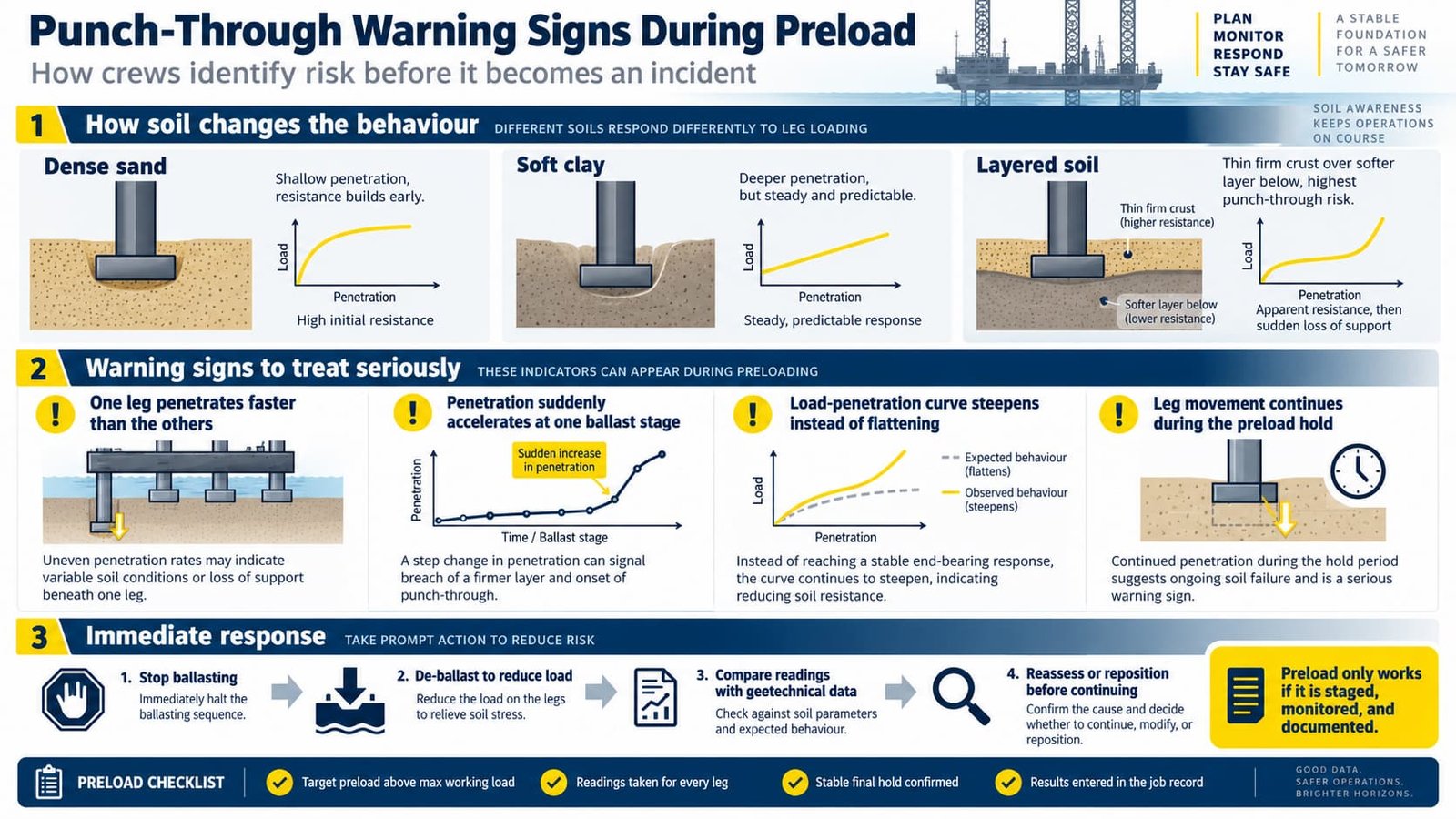
    The same barge, same legs, same spud cans will preload completely differently depending on what’s under the water. Dense sand resists penetration from the start, so legs tend to stop early and the load-penetration curve flattens quickly. Soft clay offers much less initial resistance, so legs sink further before reaching a layer firm enough to bear the load, and that deeper penetration is often normal rather than a warning sign, provided it happens at a steady, predictable rate.

    The dangerous case is layered soil. A firm sand or crust layer sitting over much softer clay can support a leg at low load, then fail suddenly once the load during preload exceeds what that thin crust layer can carry. The leg punches through the crust and drops rapidly into the softer layer below. This is precisely why preload exists and why it has to be run at a load genuinely higher than anything expected during the job, not just the expected load itself.

    How the preload sequence runs in practice

    jack-up-barge-preload

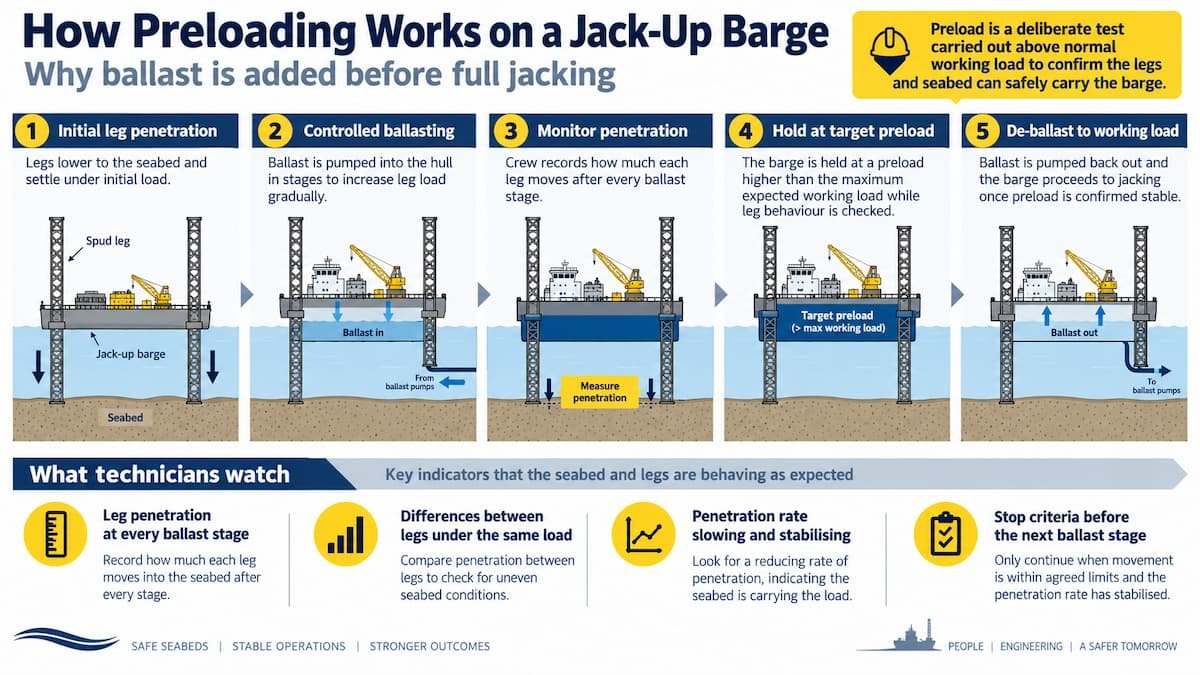
    1. Initial leg penetration. Legs lower under their own weight plus the weight already on them until they make firm contact with the seabed and penetration slows on its own.
    2. Controlled ballasting. The crew pumps ballast into the hull in stages rather than all at once, increasing the load on the legs step by step rather than applying full preload immediately.
    3. Monitoring penetration at each stage. After each ballasting step, the crew records how far each leg has moved and compares it against the previous reading, watching for a penetration rate that’s accelerating rather than settling.
    4. Holding at target preload. Once ballast reaches the target preload level, set deliberately above the maximum load the legs will see during actual work, the crew holds that load for a period and confirms penetration has stopped or is settling to a steady, acceptable rate.
    5. De-ballasting back to working load. With preload confirmed successful, ballast is pumped back out until the hull returns to its normal working weight, and the barge proceeds to full jacking.

    The staged approach matters because it gives the crew a chance to stop. Applying full preload in a single step removes the early warning that a gradual, monitored increase provides.

    Reading the signs of punch-through before it happens

    jack-up-barge-preload-warning-signs

    A load-penetration curve, which simply plots how far a leg has sunk against how much load has been applied at each stage, is the main tool here. A healthy curve flattens as load increases, meaning the soil is resisting more effectively the deeper the leg goes. A curve that stays flat and then suddenly steepens is the classic signature of a leg approaching a weak layer underneath a stronger crust.

    Other signs worth treating seriously include one leg penetrating noticeably faster than the others under the same ballast stage, since legs in similar soil should behave similarly, and any sudden jump in penetration rate at a specific ballast stage rather than a smooth progression. None of these alone proves punch-through is happening, but any of them is reason to pause ballasting and reassess rather than continue to the next stage on schedule.

    What to do when preload doesn’t go as planned

    Even with good preparation, preload sometimes reveals a problem. How the crew responds at that point matters as much as the monitoring that caught it.

    If one leg penetrates faster than the others

    Stop ballasting immediately rather than continuing to the next planned stage. Compare the affected leg’s readings against the available geotechnical data for that specific spot, since even a few metres of lateral distance can mean different soil conditions on a site with known variability. If the discrepancy can’t be explained by expected soil variation, de-ballast and reposition rather than pushing forward on the assumption it will settle out.

    If penetration suddenly accelerates during a hold

    This is the clearest punch-through signature, and the correct response is to de-ballast immediately to reduce load on the legs before penetration continues further. Once the load is reduced and the situation is stable, the crew needs to reassess the site, which may mean consulting updated geotechnical data, repositioning the barge, or adjusting the planned preload target based on what the failed attempt revealed about the actual soil profile.

    Documenting the preload for the record

    Every preload stage, its ballast level, and the corresponding leg penetration readings should go into the job record, not just a verbal confirmation that preload succeeded. This record matters for two reasons. It gives the next crew working the same site real data on what that specific location’s soil actually does under load, and it provides the documentation a classification society or client inspection may ask to see after the job.

    A preload monitoring checklist

    • Geotechnical data reviewed for this specific location, not just the general site
    • Preload target confirmed above the maximum expected working load on the legs
    • Ballasting planned in stages, not applied as a single step
    • Leg penetration recorded at every ballast stage, for every leg
    • Stop criteria agreed before starting, so the decision to pause isn’t made under pressure
    • Final preload hold confirmed stable before de-ballasting to working load

    FDC’s fleet, including AQUAQUEEN, AMIT, PRIDE 1, SANGAM 2 and AQUASTAR, carries leg and jacking system documentation maintained through its in-house shipyard in Belapur, Navi Mumbai, and crews familiar with preload conditions typical to Mumbai’s harbour and coastal sites. For technical queries on a specific vessel or job, call 98677 00755 / 93218 44408 or email famous2131@gmail.com.