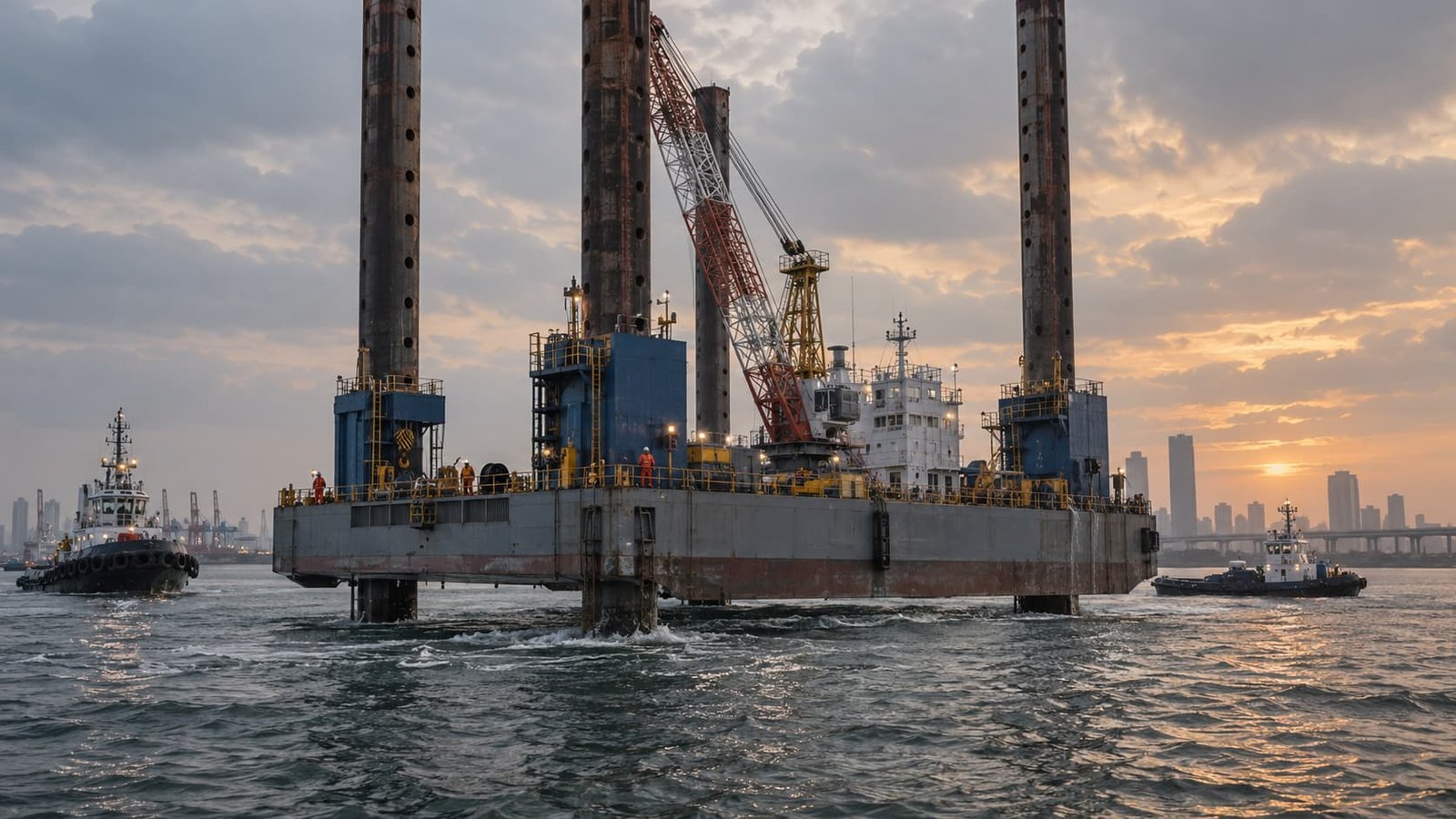
Tag: Jacking system

  • Jack-up barge de-jacking and emergency procedures: What to do when it doesn’t go to plan

    Jack-up barge de-jacking and emergency procedures: What to do when it doesn’t go to plan

    De-jacking gets treated as the easy half of the job because it looks like jacking up run backward. It isn’t. A leg that sank cleanly into soft seabed during arrival doesn’t always come out as cleanly, and a crew that’s already mentally moved on to the tow home is exactly the crew least prepared for a leg that won’t release.

    This guide covers how de-jacking actually works, what to check before starting it, and how to respond when the sequence doesn’t go to plan. It follows on from our guides on how a jack-up barge works and jack-up barge preload, which this builds on directly.

    Why de-jacking isn’t just jacking up in reverse

    Jacking up deals with resistance you can plan for in advance: you know roughly what the seabed will offer before the legs go down, and preload tests that resistance deliberately. De-jacking deals with a different problem, because by this point the legs have been sitting in the seabed for the duration of the job, sometimes for weeks, and the soil around them has had time to consolidate and grip the leg more tightly than it did on arrival.

    That grip, sometimes called suction or adhesion depending on the soil type, can resist leg extraction with a force that has little to do with how easily the leg went in. A leg that penetrated smoothly during preload can still require significantly more force to pull free during de-jacking, particularly after an extended job in clay or silt.

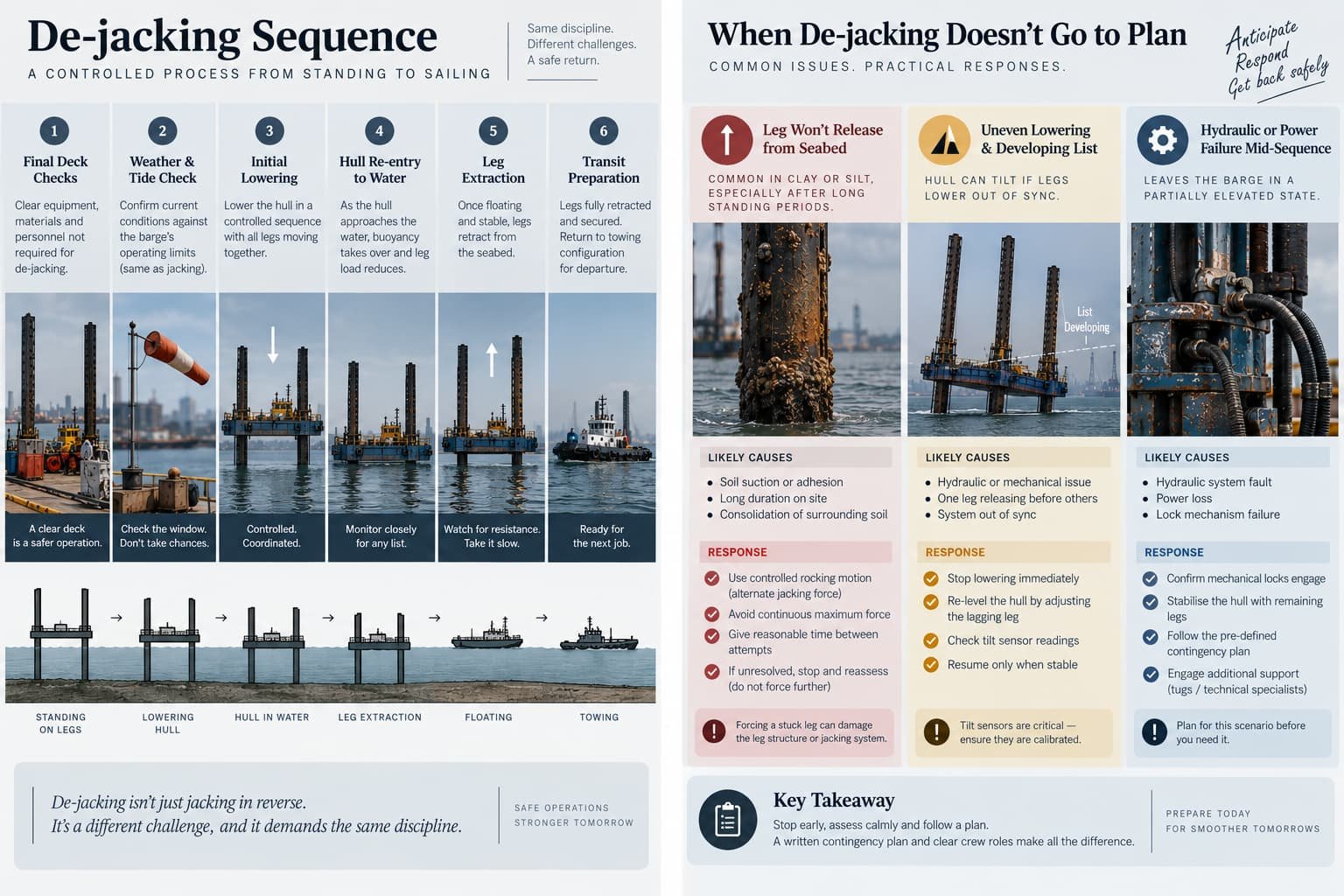
    The de-jacking sequence step by step
    jack-up-barge-de-jacking

    1. Final deck checks. Confirm all equipment, materials and personnel not required for the de-jacking operation are cleared from the deck, since the hull’s behaviour during lowering is less predictable than during stable standing mode.
    2. Weather and tide check. Confirm current conditions against the same limits used for jacking up, since lowering into open water carries the same current and wind exposure risks as the original leg lowering did.
    3. Initial lowering. The jacking system lowers the hull back down the legs in a controlled sequence, with all legs moving in coordination rather than independently.
    4. Hull re-entry to the water. As the hull approaches the water, buoyancy begins to take over from the legs, and load on the legs decreases correspondingly. This transition needs close monitoring, since an uneven transition can tilt the hull before it’s fully supported by buoyancy.
    5. Leg extraction. Once the hull is floating and stable, the legs retract from the seabed. This is where suction resistance shows up most clearly, and where the sequence most often needs to pause and reassess.
    6. Transit preparation. With legs fully retracted and secured, the barge returns to its towing configuration for departure.

    What to check before starting de-jacking

    • Soil type and how long the legs have been standing, since both affect expected extraction resistance
    • Hydraulic or rack and pinion system condition, confirmed fit for a full lowering cycle
    • Weather window checked against the barge’s stated limits, the same as for the original jacking operation
    • Tug availability confirmed for departure once the barge is back in floating mode
    • Deck cleared and crew positions assigned for the lowering sequence

    When de-jacking doesn’t go to plan

    Most de-jacking operations complete without incident, but the failure modes that do occur tend to be specific and recognisable, which makes knowing them in advance the most useful preparation a crew can have.

    A leg that won’t release from the seabed

    This is the most common de-jacking complication, particularly after a longer job in clay or fine silt. The leg has penetrated and consolidated into the soil, and simple upward force from the jacking system isn’t overcoming the suction holding it in place.

    The response here is patience over force. Applying maximum jacking force to break a stuck leg risks damaging the leg structure or the jacking system itself before it succeeds in freeing the leg. A controlled rocking motion, alternating slight increases and decreases in jacking force, often breaks the suction more effectively and more safely than sustained maximum force. If the leg still won’t release after a reasonable number of attempts, the crew needs to stop and reassess rather than continuing to force it, since continued forcing is exactly how legs and jacking components get damaged.

    Uneven lowering and developing list

    If one leg lowers out of sync with the others, whether due to a hydraulic fault, a mechanical issue, or one leg releasing from the seabed before the others, the hull can develop a list during the transition between standing and floating mode. Tilt sensors should catch this early, which is exactly why their calibration, covered in our maintenance guide, matters as much during de-jacking as during jacking up.

    The correct response is to stop the lowering sequence immediately once a list develops, rather than continuing and hoping the other legs catch up. Re-level the hull by adjusting the lagging leg’s position before resuming, even if that means the overall sequence takes longer than planned.

    Hydraulic or power failure mid-sequence

    A hydraulic failure partway through de-jacking leaves the barge in a partially elevated, partially supported state, which is one of the more serious situations a jacking system can present. Most systems include a mechanical locking feature that holds leg position if hydraulic pressure is lost, and confirming this lock engages correctly is exactly why the pre-de-jacking hydraulic check matters.

    If a lock failure leaves a leg unsupported during a power loss, the priority becomes stabilising the hull using whatever legs remain under control, rather than attempting to continue the full sequence on a partial system. This is a scenario worth planning for explicitly rather than improvising in the moment, since the right first move depends on which legs are affected and how the specific jacking system’s lock mechanism behaves.

    Building an emergency response plan before you need one

    The common thread across all three scenarios above is that the right response depends on recognising the problem early and stopping rather than pushing through on the assumption it will resolve itself. A written contingency plan, agreed before the job starts rather than improvised during an incident, should define who makes the call to stop, what the escalation path looks like, and which external support, additional tugs, technical specialists, or classification society notification, gets triggered at what stage.

    Crew roles matter here as much as the technical steps. Everyone on deck during de-jacking should know in advance who’s watching tilt readings, who’s monitoring leg load, and who has authority to halt the sequence, rather than that clarity being worked out in real time during an actual problem.

    Documenting a de-jacking incident

    Any de-jacking operation that departs from a smooth, routine sequence is worth recording in detail, including leg loads, timing, and the specific response taken, regardless of whether the situation ultimately resolved without damage. This record serves two purposes: it gives the next crew working that same site useful data on what to expect from that location’s soil, and it provides the documentation a classification society survey may ask for if the incident affected jacking system components.

    A pre-de-jacking checklist

    • Soil type and standing duration reviewed to anticipate extraction resistance
    • Hydraulic lock mechanism confirmed functional before starting
    • Weather and tide window checked against the barge’s stated limits
    • Crew roles and stop authority agreed before lowering begins
    • Tug support confirmed and on standby for departure
    • Contingency plan reviewed for stuck leg, uneven lowering and power failure scenarios

    FDC’s fleet, including AQUAQUEEN, AMIT, PRIDE 1, SANGAM 2 and AQUASTAR, is maintained through its in-house shipyard in Belapur, Navi Mumbai, with jacking system and hydraulic lock checks built into the fleet’s standard maintenance routine. For technical support on a de-jacking plan or an active jacking system issue, call 98677 00755 / 93218 44408 or email famous2131@gmail.com.

  • Jack-up barge jacking system maintenance and inspection: What technicians need to check

    Jack-up barge jacking system maintenance and inspection: What technicians need to check

    A jacking system rarely fails without warning. It fails after weeks or months of small signs that nobody logged carefully enough to notice the pattern: a slightly slower jacking speed, a hydraulic top-up that happened more often than last month, a pin that needed a bit more persuasion to seat. None of those stop a job on their own, until the day they do.

    This guide sets out what to inspect on a jack-up barge jacking system, how often, and what early wear actually looks like before it becomes a breakdown. It builds on our guides on how a jack-up barge works and jack-up barge preload, which cover the mechanism and operation this maintenance keeps reliable.

    Why Jack up barge jacking system maintenance is different from general vessel maintenance

    Most marine maintenance deals with continuous wear: hull corrosion, engine hours, running gear. A jacking system wears differently, because its hardest-working components only move during the few hours of jacking up and jacking down on each job. That intermittent use means problems can sit undetected for a long time between inspections, since the pins, racks or hydraulic seals aren’t visibly in motion most of the time a barge is in service.

    It also means the stakes are higher than they first appear. A gradual engine problem usually gives a vessel time to limp to port. A jacking system fault during an actual jacking operation, with the hull partway between floating and standing, offers much less room to respond.

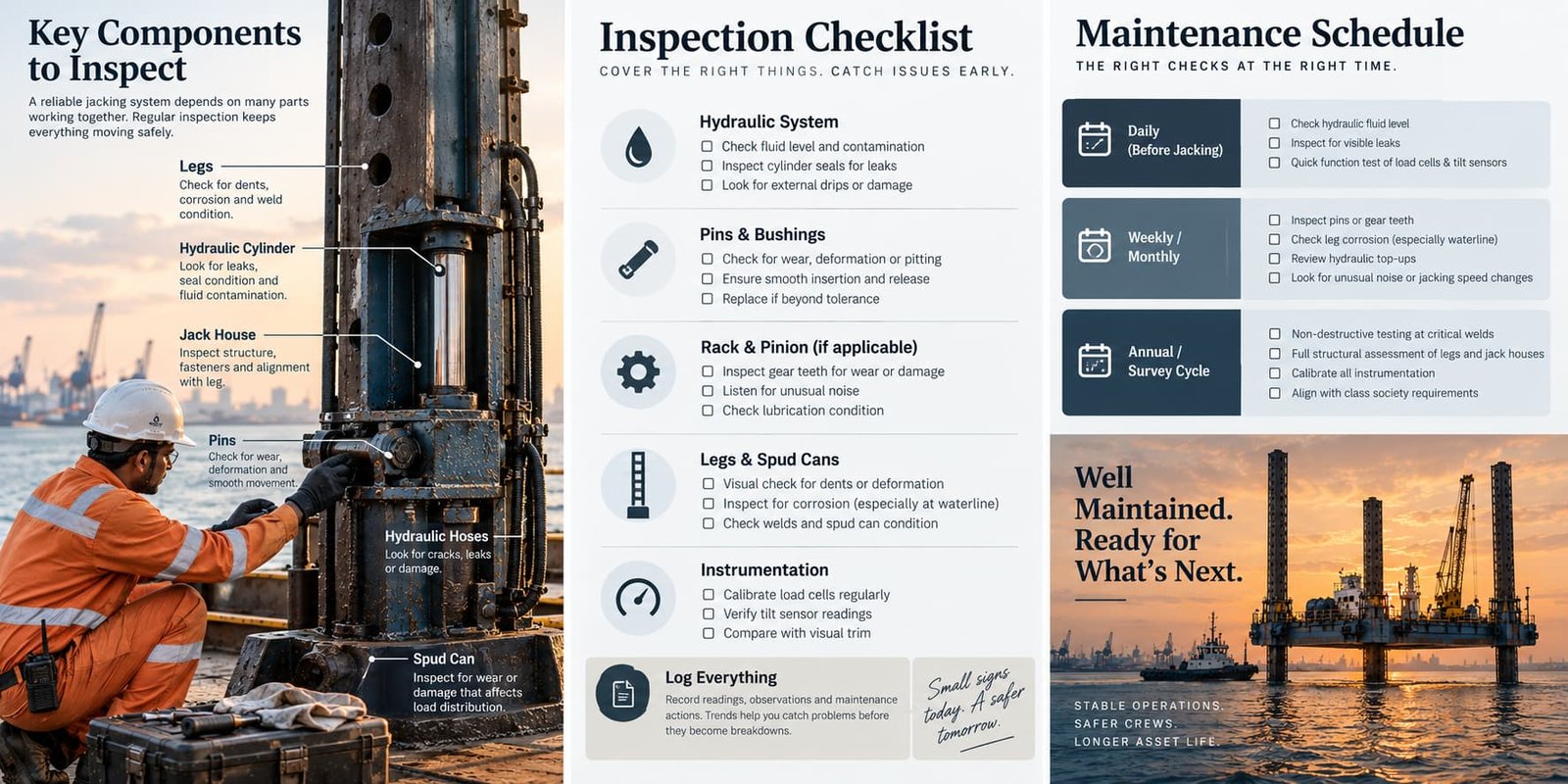
    What to inspect on a hydraulic jacking system

    Hydraulic pin and cylinder systems depend on seal integrity and fluid condition more than almost anything else. Technicians should check hydraulic fluid for contamination, since water ingress or metal particles in the fluid point to a seal or filtration problem developing elsewhere in the system. Cylinder seals themselves need a visual check for leakage at the rod, and any external drips noted during a previous jacking operation should be followed up specifically rather than assumed resolved.

    Pin condition matters just as much as the hydraulics driving them. Pins should move freely into their holes without excessive force, and any pin showing visible wear, deformation or surface pitting needs closer assessment before the next jacking operation, not after it.

    What to inspect on a rack and pinion jacking system

    Rack and pinion systems shift the inspection focus toward gear condition. Technicians should check rack and pinion teeth for wear patterns, pitting or chipping, since uneven tooth wear often signals a meshing or alignment problem rather than simple age. Motor and gearbox condition deserves the same attention, including listening for unusual noise during jacking operations, which frequently shows up before any visible wear does.

    Lubrication matters more here than on a hydraulic system, since dry or contaminated lubrication accelerates gear wear quickly. A lubrication schedule that’s followed consistently is one of the simplest ways to extend gear life on this type of system.

    Leg and structural inspection

    Check What it reveals
    Visual check for dents or deformation Impact damage that reduces a leg’s load-carrying capacity
    Corrosion inspection, especially at the waterline band Section loss that weakens the leg over time, worse in saline conditions
    Weld inspection at leg and spud can joints Fatigue cracking at high-stress connection points
    Non destructive testing at critical welds Subsurface cracking not visible to a routine visual check
    Spud can condition Wear or damage affecting how load spreads into the seabed

    Instrumentation: load cells and tilt sensors

    A jacking system is only as trustworthy as the readings a crew relies on during preload and jacking. Load cells measuring leg reaction force need periodic calibration against a known reference, since a drifted load cell can mask a genuine punch-through warning or, just as dangerously, trigger false alarms that crews start ignoring. Tilt sensors need the same discipline. A sensor reading a few degrees off during jacking can hide a real list developing in the hull until it’s visible to the eye, well past the point an accurate sensor would have flagged it.

    Building a maintenance schedule that actually gets followed

    None of the checks above help much if they exist only as a policy document nobody consults. A schedule that survives contact with a busy job calendar needs to be realistic about what gets checked when.

    Setting inspection intervals

    Daily checks before any jacking operation should cover hydraulic fluid level, visible leaks, and a quick function test of load cells and tilt sensors. Weekly or monthly checks, depending on how frequently the barge jacks, should extend to pin or gear tooth condition and a closer look at leg corrosion, particularly around the waterline band where saline exposure does the most damage. Annual or survey-cycle checks, aligned with classification society requirements, should include non destructive testing at critical welds and a full structural assessment of the legs and jack houses.

    In Mumbai’s harbour and coastal conditions specifically, saline exposure accelerates corrosion on exposed steel faster than in fresh water, which is reason enough to run the waterline corrosion check more frequently than a generic manufacturer schedule might suggest, rather than waiting for the next scheduled survey to catch it.

    Keeping a maintenance log that’s actually useful

    A maintenance log earns its value when it records trends, not just pass or fail results. Logging specific readings, hydraulic fluid top-up volume, pin insertion force, gear noise observations, lets a technician spot a slow deterioration over several jacking cycles that a single inspection would miss entirely. A log that only records “checked, OK” loses that early warning capability completely.

    Jack-up-barge-jacking-system-maintenance

    Common early warning signs worth acting on

    • Jacking speed noticeably slower than the barge’s normal baseline
    • Hydraulic fluid needing top-up more frequently than previous months
    • Unusual noise from gears or motors during jacking that wasn’t present before
    • Pins requiring more force to seat or release than usual
    • Load cell or tilt sensor readings that don’t match a visual check of the barge’s actual trim
    • New corrosion staining or surface pitting since the last inspection

    Any one of these on its own might be minor. Several appearing together, or the same one repeating across consecutive jobs, is the pattern worth stopping to investigate before the next jacking operation rather than after.

    When to take a jacking system out of service

    A jacking system should come out of service for repair when a pin, gear or hydraulic component shows wear beyond the manufacturer’s tolerance, when a load cell or tilt sensor can’t be calibrated back to an acceptable accuracy, or when non destructive testing reveals a weld defect at a leg or spud can connection. Continuing to operate past any of these points shifts risk onto the next jacking operation, at a point in the job where there’s far less room to respond safely.

    FDC’s in-house shipyard in Belapur, Navi Mumbai handles jacking system repair, pin and rack replacement, and structural leg inspection across its fleet, including AQUAQUEEN, AMIT, PRIDE 1, SANGAM 2 and AQUASTAR. For maintenance support or to schedule an inspection, call 98677 00755 / 93218 44408 or email famous2131@gmail.com.
  • Jack-up barge vs modular jack-up barge: What actually sets them apart

    Jack-up barge vs modular jack-up barge: What actually sets them apart

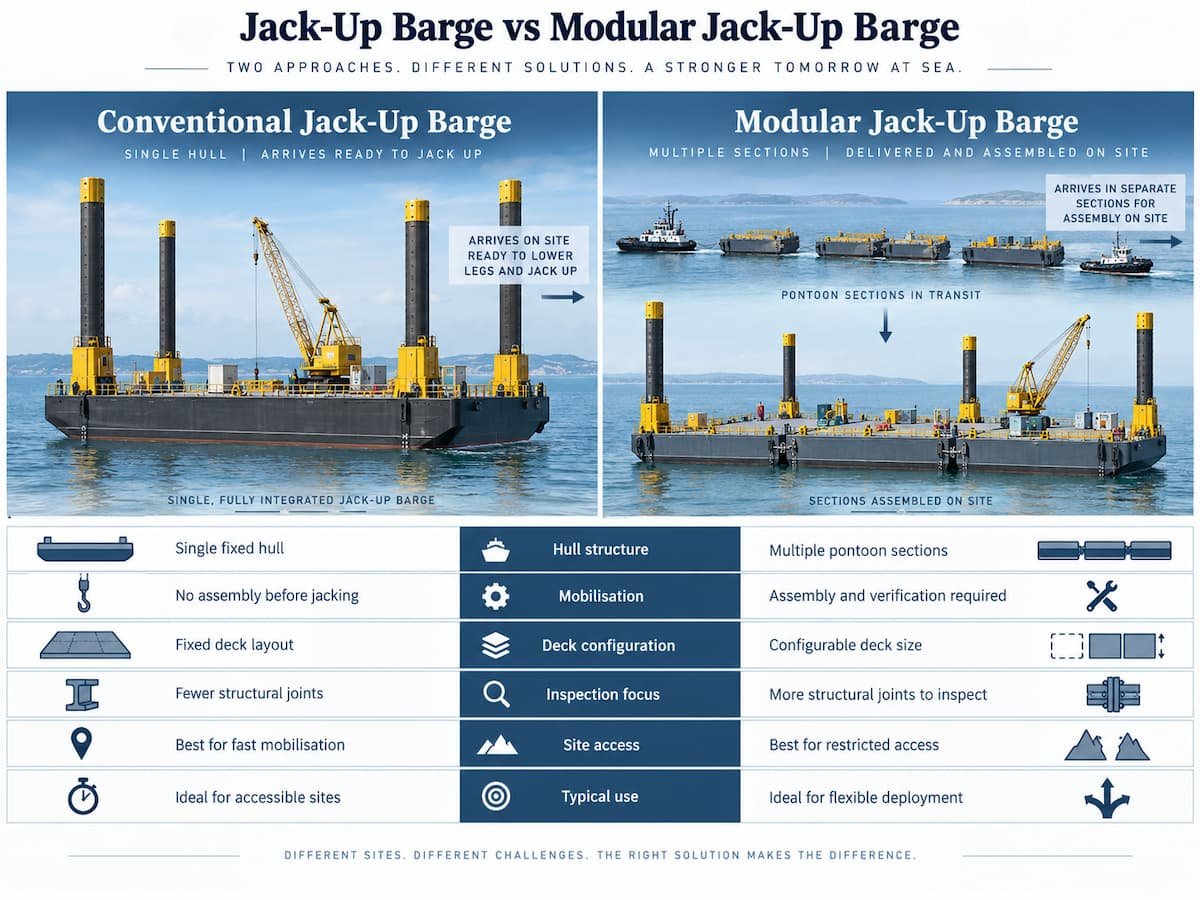
    Jack-up barge vs Modular jack-up barge: Two barges can both be called jack-up barges and still be built in almost opposite ways. One arrives as a single hull with its legs already fitted. The other arrives in pieces, gets pinned together on site, and only becomes a working platform after that assembly is complete and checked.

    Mistaking one for the other on a work plan causes real problems. A schedule that assumes a conventional jack-up’s readiness will run late if a modular unit turns up instead, and a site with restricted access will reject a monohull that a modular barge could have reached in sections. This guide sets out what actually differs between the two, from hull construction through to the structural checks a technician needs to run before either one goes to work.

    For background on how the jacking mechanism itself operates once a barge is standing on its legs, see our guide on how a jack-up barge works.

    What separates a jack-up barge from a modular jack-up barge

    A conventional jack-up barge is built as one continuous hull, with legs and jacking systems fitted during construction and never removed. It arrives at a site ready to lower its legs and jack up, with no assembly step in between.

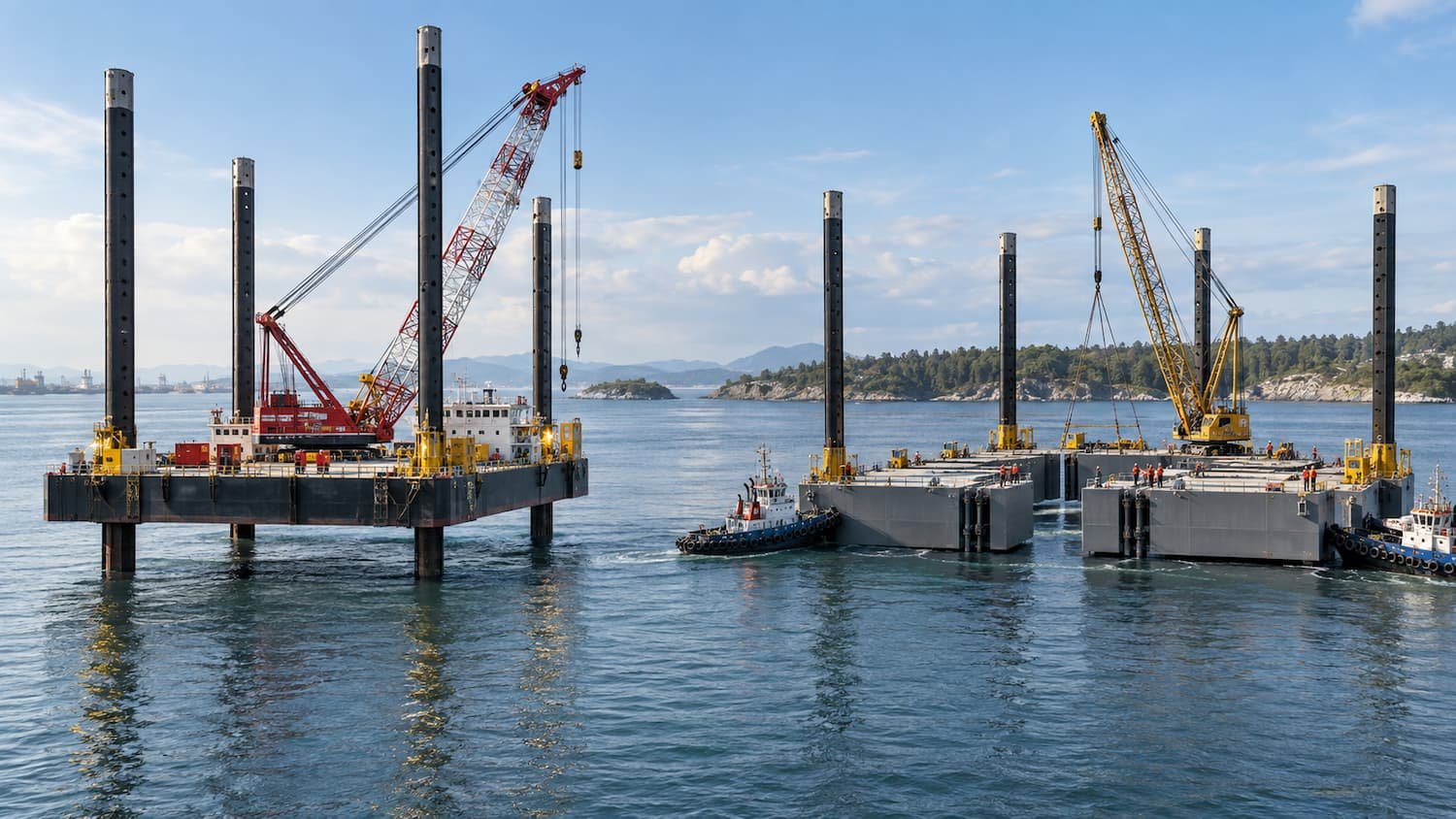
    A modular jack-up barge is built from separate pontoon sections, each one a self-contained buoyant unit, that get connected on site using pins, bolts or a combination of both. Legs and jacking systems are often fitted to the assembled unit rather than to individual modules, though some designs mount jacking systems on specific corner sections. Once connected and checked, the modular unit functions exactly like a conventional jack-up barge for the rest of the job.

    So the difference isn’t in what the barge does once it’s standing. It’s in how the barge gets to that standing configuration in the first place.

    Hull construction: Monohull vs pontoon sections

    A monohull jack-up barge is a fixed structure. Its dimensions, deck layout and leg positions are set at build time and don’t change between jobs. That fixed design means fewer structural joints, which means fewer places for fatigue cracking or connection wear to develop over the barge’s working life.

    A modular barge trades that structural simplicity for flexibility. Each pontoon section connects to its neighbours through pin joints or bolted flanges, and those connections carry real structural load once the unit is jacked up and working. That’s the trade-off in one sentence: a monohull gives you fewer parts to inspect but no flexibility in size, while a modular barge gives you configurable deck area but adds structural connections that need their own inspection regime.

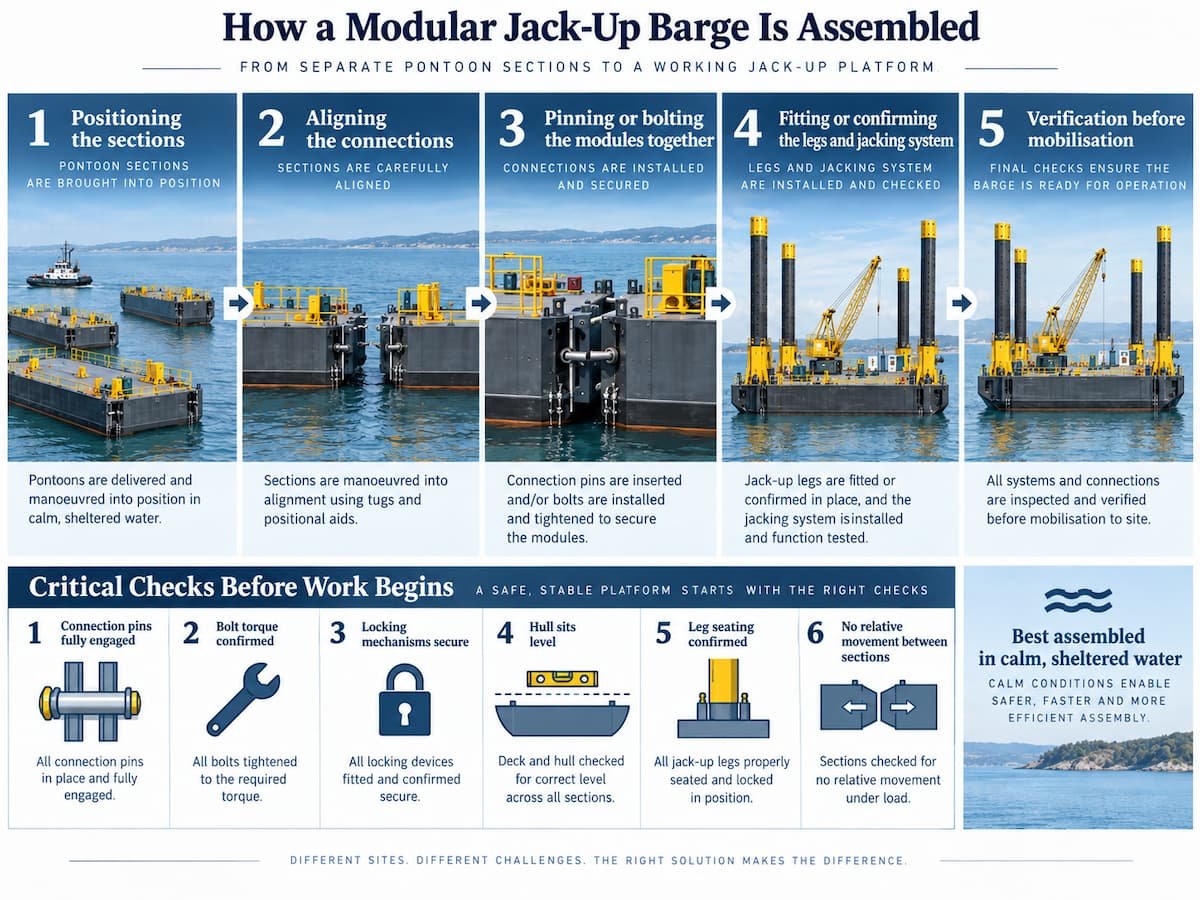
    How a modular jack-up barge actually gets assembled

    Assembly usually happens in calm, sheltered water rather than at the final work site, since alignment tolerances on the connecting pins are tight and any swell makes that alignment harder to achieve safely.

    1. Positioning the sections. Tugs bring each pontoon module alongside the others in the planned configuration, guided by fender systems or temporary lines to hold rough alignment.
    2. Aligning the connections. Crews align pin sleeves or bolt holes between adjacent sections, often using guide cones or tapered pins to bring rough alignment into precise alignment.
    3. Making the connection. Pins are driven home or bolts torqued to specification, and on some designs a secondary locking mechanism secures the primary connection against vibration loosening it over time.
    4. Fitting or confirming the legs. Depending on the design, legs are either already mounted on specific modules and simply confirmed as seated correctly, or fitted to the assembled unit at this stage.
    5. Verification. Before the unit moves to its work location, the crew checks that every connection is fully engaged and that the assembled hull sits level, since an uneven assembly puts uneven load on the legs the moment jacking begins.

    modular-jackup-barge-assembly

    None of this is fast. Assembly typically adds a mobilisation step that a monohull simply doesn’t need, and it’s worth planning for in any schedule that specifies a modular unit.

    Jack-up barge vs Modular jack-up barge: Jacking system differences

    Factor Conventional jack-up barge Modular jack-up barge
    Hull structure Single fixed hull Multiple pontoon sections joined on site
    Mobilisation before jacking Legs lowered directly, no assembly needed Sections must be assembled and verified first
    Deck configuration Fixed at build time Adjustable by adding or removing modules
    Structural joints to inspect Minimal, mainly leg and jack house connections Leg and jack house connections, plus every inter-module joint
    Site access Limited by the hull’s fixed dimensions Sections can transit narrow channels separately
    Typical use case Repeat jobs at accessible sites needing fast turnaround Restricted-access sites or jobs needing a non-standard deck size

    jack-up-barge-vs-modular-jack-up-barge

    What the construction difference means for fieldwork

    The mechanical distinction above translates directly into how each barge behaves on a real job, and this is where it matters most for the crew actually running the operation.

    Mobilisation time and site access

    A conventional jack-up barge wins on speed to first jack-up, since there’s no assembly step to complete before the legs go down. That makes it the better choice for jobs where the barge needs to be operational quickly, or where it moves between several nearby sites in succession.

    A modular barge earns its keep on access. Individual pontoon sections often have a shallower transit draft and a smaller footprint than an equivalent single hull, which means they can reach a berth or channel a monohull physically can’t enter. FDC’s fleet reflects this split directly: AQUAQUEEN operates as a conventional jack-up barge, while AMIT, PRIDE 1, SANGAM 2 and AQUASTAR are modular units built for exactly this kind of flexible deployment.

    Deck load and configuration flexibility

    Because a modular barge’s deck area comes from however many sections are connected, its usable deck load and layout can change between jobs in a way a monohull’s can’t. Adding a section increases both deck area and buoyancy, which is useful when a job needs a bigger working platform than a single hull would provide.

    That flexibility comes with a technical catch. Total deck load capacity on a modular unit depends on the combined structural rating of the assembled sections, not just the strength of any one module. A technician planning a heavy lift on a modular barge needs the assembled unit’s rated capacity, not the rating of an individual pontoon section considered on its own.

    Structural connections and what to inspect

    The inter-module connections on a modular barge carry genuine structural load once the unit is jacked up, so they need their own inspection routine separate from the leg and jacking system checks covered in our jacking system guide. Pin wear, bolt torque retention and any sign of relative movement between sections all matter here, since a connection that’s loosened slightly under cyclic loading can allow flexing that a monohull’s welded structure simply doesn’t experience.

    A conventional jack-up barge avoids this category of inspection entirely, because it has no equivalent joints. Its structural attention goes almost entirely to the legs, jack houses and hull plating, the same checks covered for any jack-up unit.

    Maintenance planning across the two types

    Maintenance intervals for the jacking system, legs and hull plating are broadly similar between the two barge types, since both rely on the same underlying jacking mechanisms once assembled. The real difference sits in the additional connection inspection a modular barge requires, and in the fact that a modular unit’s individual sections can be pulled out of service and swapped or repaired without taking the whole barge out of rotation, something a monohull can’t do.

    Jack-up barge vs Modular jack-up barge: Choosing the right type for the job, from a technical standpoint

    Use a conventional jack-up barge when the site is easily accessible, the deck requirement is standard, and fast mobilisation matters more than configuration flexibility. Use a modular jack-up barge when the site has restricted access, when the job needs a deck size that doesn’t match a standard hull, or when individual sections may need to be serviced or swapped without losing the whole unit.

    Neither type is inherently the safer or stronger option. Each does its job well within the conditions it was designed for, and most of the risk in either case comes from skipping the inspection steps specific to that barge’s construction, not from the construction type itself.

    FDC operates both types from its Mumbai base, with an in-house shipyard in Belapur, Navi Mumbai handling structural inspection, connection maintenance and jacking system repairs across the fleet. For technical specifications on a specific vessel or to discuss which type suits a project, call 98677 00755 / 93218 44408 or email famous2131@gmail.com.
  • How does a jack-up barge work? A technician’s guide to the jacking system

    How does a jack-up barge work? A technician’s guide to the jacking system

    A jack-up barge only looks calm once it is standing on its legs. Getting it there is the part that separates a routine mobilisation from a serious incident, and most of what goes wrong happens in the few hours between the legs touching the seabed and the hull clearing the water.

    This guide is written for the people who actually run that process: barge crew, site engineers and technicians working on marine construction, dredging support and harbour projects. It explains how the jacking system physically lifts a barge clear of the water, walks through the elevation sequence stage by stage, and covers what to check before and during a jacking operation.

    If you’re reviewing FDC’s own fleet before a job, our jack-up barge fleet page lists current specifications for AQUAQUEEN, AMIT, PRIDE 1 and the rest of the units.

    What a jack-up barge actually is

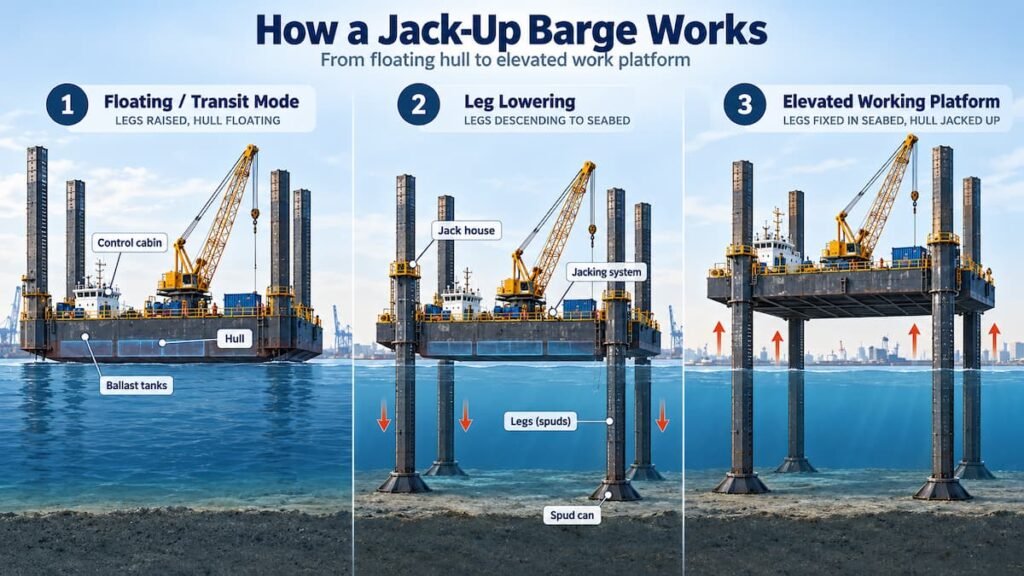
    A jack-up barge is a floating hull fitted with movable legs. During transit, the legs sit raised above the hull and the unit behaves like any other barge, riding on buoyancy alone. Once it reaches the work site, the legs lower until they reach the seabed, and the jacking system then pushes the hull upward along the legs until it clears the water entirely.

    That last part is what makes a jack-up different from a conventional pontoon or flat top barge. A pontoon stays afloat throughout a job, so it still moves with waves, current and tide.

    A jack-up barge, once elevated, is effectively a fixed platform standing on the seabed. Waves pass underneath it instead of moving it, which is exactly why the technique exists: it gives you a stable working deck in conditions where a floating barge would be too unsteady for piling, crane work or precision fabrication.

    The components that make elevation possible

    Every jack-up barge relies on the same basic set of parts, even though the scale and design vary between a small harbour unit and a large offshore platform.

    Component What it does
    Hull Provides buoyancy during transit and houses equipment, machinery and, on larger units, accommodation
    Legs (spuds) Tubular or lattice structures, usually 3, 4, 6 or 8 per barge, that transfer load down to the seabed
    Spud can A widened footing at the base of each leg that spreads the load over a larger area, reducing how far the leg penetrates the seabed
    Jack house The structure at each leg position on the hull that contains the jacking mechanism
    Jacking system The mechanism, hydraulic or rack and pinion, that moves the hull up and down the legs
    Ballast system Tanks and pumps used to control trim and to add controlled weight during preloading
    Control cabin Where the operator synchronises jacking across all legs and monitors load and tilt readings

    How the jacking system actually lifts the platform

    how-jack-up-barge-works

    Two mechanisms account for most jack-up barges in service. The first is a hydraulic pin and cylinder system, sometimes called a climbing jack.

    Hydraulic cylinders grip pinholes along the leg, extend to push the hull up a fixed increment, release, reset lower, and grip again, much like a person climbing a ladder hand over hand. It’s mechanically simple, which is one reason many modular jack-up barges use it.

    The second is a rack and pinion system, more common on larger offshore units. Motor-driven gears mesh with a rack running the length of the leg and rotate to drive the hull up or down continuously, rather than in steps. It moves more smoothly but adds mechanical complexity and cost, so it tends to appear on bigger platforms where that trade-off makes sense.

    Either way, the principle is the same. The legs stay fixed once they’re planted on the seabed, and the jacking system moves the hull relative to them, not the other way round.

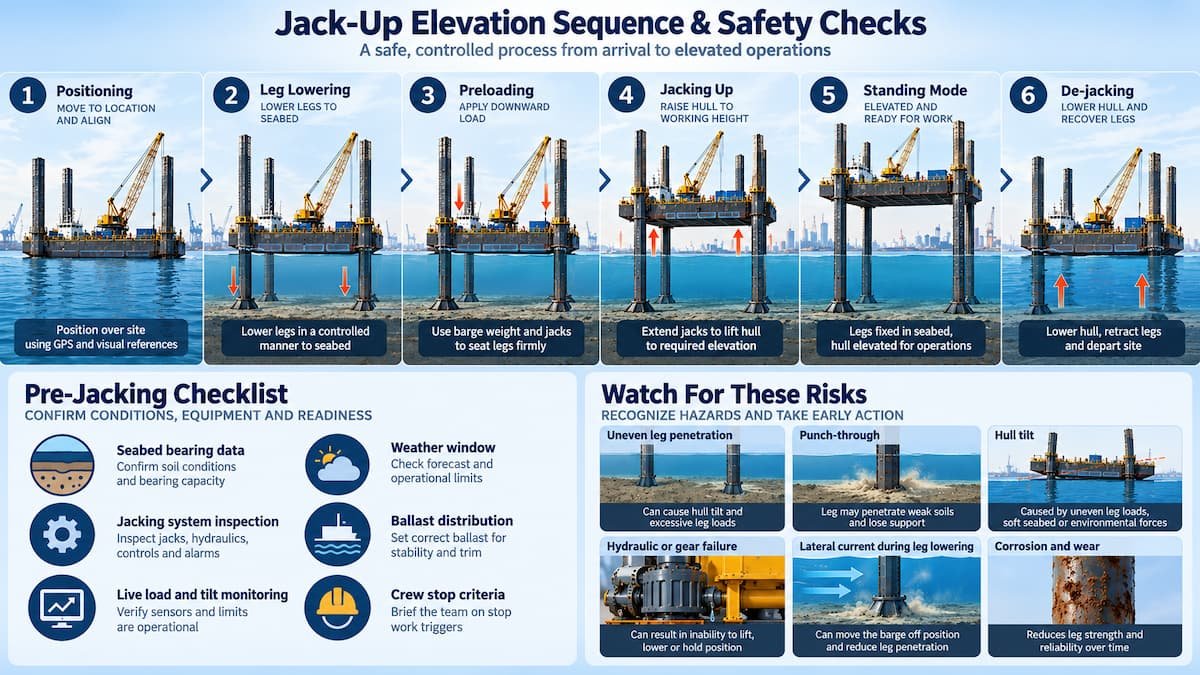
    The elevation sequence step by step

    1. Positioning. Tugs move the barge into place and hold it on location while the legs are still raised.
    2. Leg lowering. The legs lower until the spud cans reach the seabed. How far they penetrate depends entirely on the soil. In dense sand, a leg might stop within a shallow depth. In soft harbour mud, the same leg can sink much deeper before it reaches a layer firm enough to bear load.
    3. Preloading. Before committing full weight to the legs, the crew pumps additional ballast into the hull to simulate the maximum load the legs will carry during the job. This is deliberate over-testing: if a leg is going to punch through a weak soil layer, you want that to happen now, at low air gap, rather than later with the deck fully loaded.
    4. Jacking up. Once preload holds without excessive or uneven penetration, the jacking system raises the hull up the legs until it clears the highest expected wave crest for the operating window, with margin for tidal range.
    5. Standing mode. The barge now behaves as a fixed platform. Deck operations, whether that’s piling support, crane lifts or fabrication work, proceed as if on solid ground.
    6. De-jacking. To leave, the sequence reverses: the hull lowers back into the water, the legs retract, and the barge returns to floating mode for towing.

    jack-up-elevation-sequence-checks

    Getting the jacking operation right on site

    Understanding the mechanism is one thing. Running the operation safely is another, and that comes down to a handful of checks before you start and a few things you watch closely once the legs go down.

    Checks before you start jacking

    • Confirm seabed bearing capacity from a survey or previous data for that berth, since the same barge behaves very differently on sand, mud or rock
    • Check the weather window against your barge’s stated wave height and wind limits, since jacking in swell puts impact loads on the legs before they’ve found a stable footing
    • Pressure-test the hydraulic system if it’s a climbing jack unit, or check gear and motor condition on a rack and pinion system
    • Verify ballast is distributed to keep the hull level before you begin lowering the legs

    What to monitor once jacking begins

    Leg load readings and tilt indicators are your early warning system. All legs should show a similar penetration rate as they go down.

    If one leg penetrates noticeably faster than the others, that’s often the first sign it has found a weaker soil layer, and it’s the point to stop and reassess rather than push through and hope it settles.

    A sudden, uncontrolled drop in one leg during preload is a punch-through, and it’s exactly what the preload stage exists to catch before the deck carries real weight.

    Jack-up barge vs modular jack-up barge: what changes on site

    A conventional jack-up barge has its legs permanently fitted to a single hull, so it’s ready to work as soon as it arrives. A modular jack-up barge is assembled on site from separate pontoon sections bolted or pinned together, with legs added afterward.

    That first assembly takes longer, but it means the unit can reach sites with restricted access, narrow channels or limited berth space that a single large hull couldn’t get into. It also means the deck configuration can change between jobs by adding or removing pontoon modules. We’ll cover this comparison in more depth, including deck load and mobilisation trade-offs, in a separate guide.

    Where things go wrong

    Most jack-up incidents trace back to a small set of causes. Punch-through remains the most serious, where a leg breaks through a firm crust into a much softer layer underneath, faster than the preload stage anticipated. Uneven preload across legs, often from ballast not being distributed evenly, produces tilt that gets worse as jacking continues.

    Hydraulic leaks can halt a climbing jack system mid-lift, leaving one leg out of sync with the others. Lateral current during leg lowering can also damage a leg before it even reaches the seabed. In Mumbai’s saline harbour conditions specifically, corrosion on jacking pins and rack teeth accelerates faster than in fresh water, which is one more reason inspection intervals matter more here than the manufacturer’s default schedule might suggest.

    Keeping the jacking system in working order

    Routine inspection should cover pin and rack wear, hydraulic fluid condition, and the structural condition of the legs themselves, since dents or corrosion reduce how much load a leg can safely carry.

    Load cell and tilt sensor calibration deserves the same attention, because a jacking operation is only as safe as the readings the crew is trusting. Beyond routine inspection, follow your vessel’s classification society survey cycle for the jacking system and legs, not just the hull.

    A quick pre-jacking checklist

    • Seabed bearing data confirmed for this specific berth
    • Weather window checked against wave height and wind limits
    • Hydraulic or rack and pinion system inspected and pressure-tested
    • Ballast distributed evenly before leg lowering begins
    • Leg load and tilt monitoring live and confirmed working
    • Stop criteria agreed with the crew before jacking starts, not during it

    FDC’s own fleet includes both conventional jack-up barges like AQUAQUEEN and modular units including AMIT, PRIDE 1, SANGAM 2 and AQUASTAR, supported by an in-house shipyard in Belapur, Navi Mumbai for repairs, modifications and jacking system maintenance. For charter availability or technical specifications on a specific vessel, call 98677 00755 / 93218 44408 or email famous2131@gmail.com.