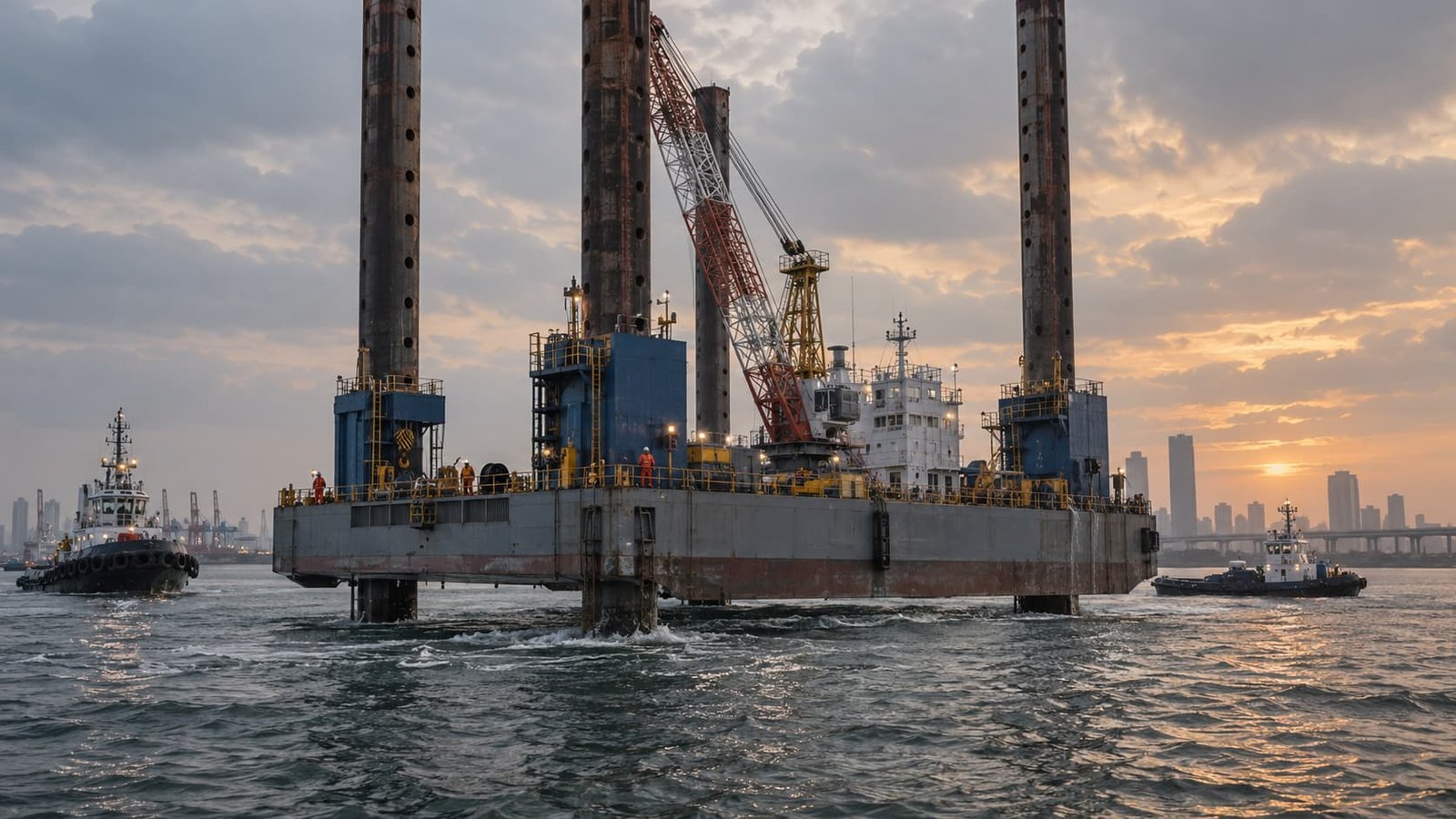
De-jacking gets treated as the easy half of the job because it looks like jacking up run backward. It isn’t. A leg that sank cleanly into soft seabed during arrival doesn’t always come out as cleanly, and a crew that’s already mentally moved on to the tow home is exactly the crew least prepared for a leg that won’t release.
This guide covers how de-jacking actually works, what to check before starting it, and how to respond when the sequence doesn’t go to plan. It follows on from our guides on how a jack-up barge works and jack-up barge preload, which this builds on directly.
Why de-jacking isn’t just jacking up in reverse
Jacking up deals with resistance you can plan for in advance: you know roughly what the seabed will offer before the legs go down, and preload tests that resistance deliberately. De-jacking deals with a different problem, because by this point the legs have been sitting in the seabed for the duration of the job, sometimes for weeks, and the soil around them has had time to consolidate and grip the leg more tightly than it did on arrival.
That grip, sometimes called suction or adhesion depending on the soil type, can resist leg extraction with a force that has little to do with how easily the leg went in. A leg that penetrated smoothly during preload can still require significantly more force to pull free during de-jacking, particularly after an extended job in clay or silt.
The de-jacking sequence step by step
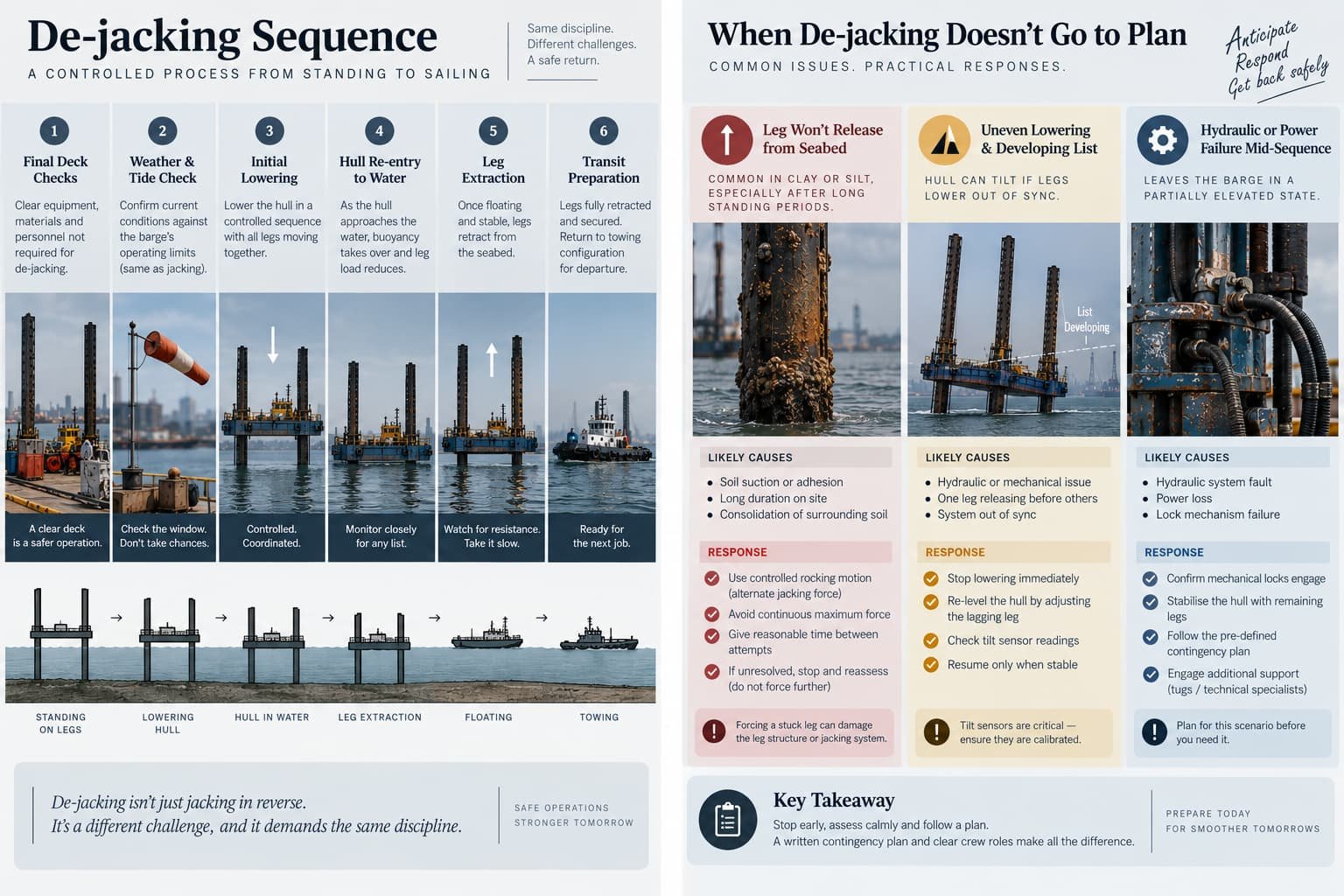
- Final deck checks. Confirm all equipment, materials and personnel not required for the de-jacking operation are cleared from the deck, since the hull’s behaviour during lowering is less predictable than during stable standing mode.
- Weather and tide check. Confirm current conditions against the same limits used for jacking up, since lowering into open water carries the same current and wind exposure risks as the original leg lowering did.
- Initial lowering. The jacking system lowers the hull back down the legs in a controlled sequence, with all legs moving in coordination rather than independently.
- Hull re-entry to the water. As the hull approaches the water, buoyancy begins to take over from the legs, and load on the legs decreases correspondingly. This transition needs close monitoring, since an uneven transition can tilt the hull before it’s fully supported by buoyancy.
- Leg extraction. Once the hull is floating and stable, the legs retract from the seabed. This is where suction resistance shows up most clearly, and where the sequence most often needs to pause and reassess.
- Transit preparation. With legs fully retracted and secured, the barge returns to its towing configuration for departure.
What to check before starting de-jacking
- Soil type and how long the legs have been standing, since both affect expected extraction resistance
- Hydraulic or rack and pinion system condition, confirmed fit for a full lowering cycle
- Weather window checked against the barge’s stated limits, the same as for the original jacking operation
- Tug availability confirmed for departure once the barge is back in floating mode
- Deck cleared and crew positions assigned for the lowering sequence
When de-jacking doesn’t go to plan
Most de-jacking operations complete without incident, but the failure modes that do occur tend to be specific and recognisable, which makes knowing them in advance the most useful preparation a crew can have.
A leg that won’t release from the seabed
This is the most common de-jacking complication, particularly after a longer job in clay or fine silt. The leg has penetrated and consolidated into the soil, and simple upward force from the jacking system isn’t overcoming the suction holding it in place.
The response here is patience over force. Applying maximum jacking force to break a stuck leg risks damaging the leg structure or the jacking system itself before it succeeds in freeing the leg. A controlled rocking motion, alternating slight increases and decreases in jacking force, often breaks the suction more effectively and more safely than sustained maximum force. If the leg still won’t release after a reasonable number of attempts, the crew needs to stop and reassess rather than continuing to force it, since continued forcing is exactly how legs and jacking components get damaged.
Uneven lowering and developing list
If one leg lowers out of sync with the others, whether due to a hydraulic fault, a mechanical issue, or one leg releasing from the seabed before the others, the hull can develop a list during the transition between standing and floating mode. Tilt sensors should catch this early, which is exactly why their calibration, covered in our maintenance guide, matters as much during de-jacking as during jacking up.
The correct response is to stop the lowering sequence immediately once a list develops, rather than continuing and hoping the other legs catch up. Re-level the hull by adjusting the lagging leg’s position before resuming, even if that means the overall sequence takes longer than planned.
Hydraulic or power failure mid-sequence
A hydraulic failure partway through de-jacking leaves the barge in a partially elevated, partially supported state, which is one of the more serious situations a jacking system can present. Most systems include a mechanical locking feature that holds leg position if hydraulic pressure is lost, and confirming this lock engages correctly is exactly why the pre-de-jacking hydraulic check matters.
If a lock failure leaves a leg unsupported during a power loss, the priority becomes stabilising the hull using whatever legs remain under control, rather than attempting to continue the full sequence on a partial system. This is a scenario worth planning for explicitly rather than improvising in the moment, since the right first move depends on which legs are affected and how the specific jacking system’s lock mechanism behaves.
Building an emergency response plan before you need one
The common thread across all three scenarios above is that the right response depends on recognising the problem early and stopping rather than pushing through on the assumption it will resolve itself. A written contingency plan, agreed before the job starts rather than improvised during an incident, should define who makes the call to stop, what the escalation path looks like, and which external support, additional tugs, technical specialists, or classification society notification, gets triggered at what stage.
Crew roles matter here as much as the technical steps. Everyone on deck during de-jacking should know in advance who’s watching tilt readings, who’s monitoring leg load, and who has authority to halt the sequence, rather than that clarity being worked out in real time during an actual problem.
Documenting a de-jacking incident
Any de-jacking operation that departs from a smooth, routine sequence is worth recording in detail, including leg loads, timing, and the specific response taken, regardless of whether the situation ultimately resolved without damage. This record serves two purposes: it gives the next crew working that same site useful data on what to expect from that location’s soil, and it provides the documentation a classification society survey may ask for if the incident affected jacking system components.
A pre-de-jacking checklist
- Soil type and standing duration reviewed to anticipate extraction resistance
- Hydraulic lock mechanism confirmed functional before starting
- Weather and tide window checked against the barge’s stated limits
- Crew roles and stop authority agreed before lowering begins
- Tug support confirmed and on standby for departure
- Contingency plan reviewed for stuck leg, uneven lowering and power failure scenarios
FDC’s fleet, including AQUAQUEEN, AMIT, PRIDE 1, SANGAM 2 and AQUASTAR, is maintained through its in-house shipyard in Belapur, Navi Mumbai, with jacking system and hydraulic lock checks built into the fleet’s standard maintenance routine. For technical support on a de-jacking plan or an active jacking system issue, call 98677 00755 / 93218 44408 or email famous2131@gmail.com.